
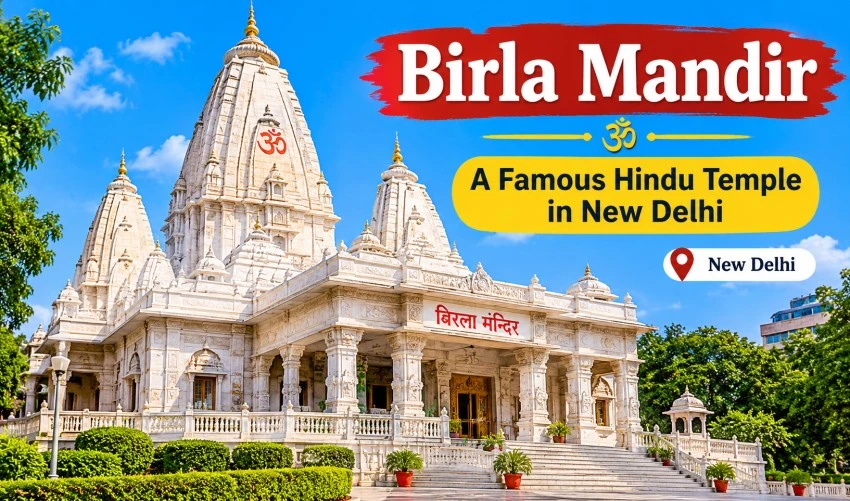
Not far from the busy streets of Connaught Place, a tall, ornate temple rises above the rooftops of Mandir Marg. Birla Mandir, officially the Laxminarayan Temple, is one of the best-known places of worship in the capital. It welcomes thousands of devotees and travellers, and it is often one of the first temples that first-time visitors to Delhi are told to see. This guide covers its history, architecture, timings, festivals and the easiest ways to get there.
About Birla Mandir
The temple is dedicated to Lord Vishnu and his consort, Goddess Lakshmi, who are worshipped together as Laxminarayan. It is called Birla Mandir because it was built by the Birla family. It was the first large Hindu temple built in Delhi, which gives it a special place in the city’s religious history. Today it remains active and well loved, and it is open to people of every background.
History of the Temple
The temple was the vision of the industrialist Baldeo Das Birla and his son Jugal Kishore Birla. Construction took place between 1933 and 1939. This was a time when India’s freedom movement was at its height, and the temple was designed to be open to all.
One of the most interesting facts about the temple is its inclusive approach. Mahatma Gandhi is said to have inaugurated it, and he emphasised that devotees of all castes, whether Brahmin or Shudra, should be allowed to pray there. At a time when many temples restricted entry, this was a significant step, and it still gives the temple a special meaning today.
Architecture and Design
The temple was designed in the Nagara style, which is common in North Indian temples. Its tall spires, carved panels and cream and red tones make it easy to recognise. According to one source, more than a hundred skilled artisans from Varanasi worked on it, and its highest shikhara rises to 160 feet. The architect is named in some sources as Sris Chandra Chatterjee, a leading figure of the modern Indian architecture movement.
Inside, the walls are decorated with scenes from Hindu epics and with verses from sacred texts. The garden and its landscaping add to the calm atmosphere, and artificial landscaping and cascading waterfalls add to the scenic charm. The overall effect is of a peaceful, open space, and it is a pleasant place to sit for a few minutes away from the traffic.
Main Shrines
The central shrine houses the idols of Lord Vishnu and Goddess Lakshmi. Around the complex there are other shrines too. Other shrines house Lord Shiva, Ganesha and Lord Hanuman, and there is also a shrine for Lord Buddha. There is also a shrine of Goddess Durga on one side, which becomes a special attraction during Navratri. This mix of deities makes the temple welcoming to worshippers from different traditions.
Darshan Timings
The temple follows a simple daily schedule, with a break in the afternoon:
| Session | Timings |
|---|---|
| Morning | 4:30 AM – 1:30 PM |
| Evening | 2:30 PM – 9:00 PM |
These timings are reported consistently by the Delhi Tourism website, which also recommends the morning and evening aartis. A few sources say the temple stays open longer on Sundays, while others do not mention it, so confirm locally if you plan to arrive late or very early on a Sunday or on a festival day. There is no entry fee.
Best Time to Visit
If you want a quieter, more reflective visit, go early in the morning on a weekday. If you prefer atmosphere, go during the evening aarti, when the temple is lit and the chanting fills the courtyard. One source suggests that Friday evening during aarti is a particularly good time to visit. Winter, from October to March, is the most comfortable season, since Delhi’s summer afternoons can be harsh.
Festivals at Birla Mandir
The temple is at its liveliest during festivals. Thousands of devotees gather on Janmashtami and Diwali, and the temple is decorated with lights, flowers and special displays. Navratri, Ram Navami and Maha Shivratri are also celebrated with devotion. If you want to see the temple at its most festive, these are the days to choose, though you should expect long queues and heavy crowds.
How to Reach Birla Mandir
- Address: Mandir Marg, near Gole Market, New Delhi – 110001.
- By Metro: The nearest metro station is Ramakrishna Ashram Marg, about 1.5 km from the temple. Rajiv Chowk and Patel Chowk are also within reach, and from any of them you can take an auto or e-rickshaw for the final stretch.
- By Train: The temple is about 4 km from New Delhi Railway Station. A cab or auto from the station takes only a few minutes outside peak hours.
- By Road: Buses run to Connaught Place and Gole Market, and app-based cabs are the easiest option from other parts of the city. Parking near the temple is limited, so public transport is usually less stressful.
- By Air: Indira Gandhi International Airport is roughly 15 to 18 km away. You can take a cab directly or use the Airport Express to New Delhi station and continue by auto.
Rules and Tips for Visitors
- Remove your shoes at the counter before entering, and keep the token safe.
- Dress modestly, covering shoulders and knees.
- Leave your phone and camera at the cloakroom if you are asked to, since photography is usually restricted inside the main areas.
- Carry minimal belongings. Large bags and some electronics are often not allowed, and security checks can take time.
- Avoid peak festival hours if you are travelling with young children or senior citizens.
- Stay quiet and respectful, and follow the instructions of temple staff.
- Keep valuables safe, as with any crowded place in the city.
Places to Visit Nearby
The temple’s central location makes it easy to combine with other sights:
- Connaught Place for shopping, cafés and heritage buildings.
- Jantar Mantar, the 18th-century astronomical observatory.
- Gurudwara Bangla Sahib, one of Delhi’s most visited Sikh shrines.
- Gole Market, a historic market nearby.
- India Gate and the Rajpath area, a short drive away.
A morning at the temple followed by lunch at Connaught Place and an afternoon at Jantar Mantar makes a well-paced half-day itinerary.
Final Thoughts
Birla Mandir is more than a landmark on a tourist list. It is an important piece of Delhi’s modern religious history, a place built with a spirit of openness, and a calm refuge in a busy part of the city. With free entry, central location and easy transport links, it is simple to add to almost any itinerary. Arrive early, dress respectfully, and allow yourself time to walk through the gardens and listen to the aarti before you head back into the city.