
When the COVID-19 pandemic swept across the world in 2020, it left no city untouched — and Delhi, India’s densely populated capital, faced some of its most severe waves with devastating consequences. The answer to the crisis, as health experts worldwide agreed, lay in mass vaccination. What followed in Delhi — and across India — was one of the most ambitious public health undertakings in human history: a nationwide immunisation drive that would eventually administer over 2.2 billion doses across the country and set new global benchmarks for the speed and scale of vaccine delivery.
At the centre of this effort was the CoWIN platform — a digital infrastructure that enabled citizens to register, book appointments, and receive vaccination certificates entirely online. For residents of Delhi and the NCR, understanding how to navigate this system was essential. This article is a comprehensive guide to corona vaccine registration in Delhi — covering the CoWIN platform, the step-by-step registration process, required documents, vaccination centre access, the precaution (booster) dose, and the broader story of how Delhi vaccinated its millions.
The CoWIN Platform: India’s Digital Vaccine Backbone
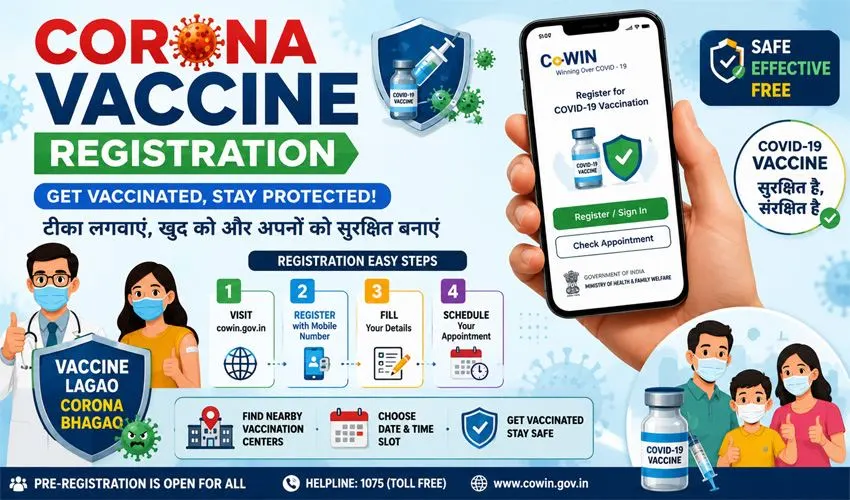
The backbone of India’s COVID-19 vaccination registration system was the Co-WIN platform — an acronym for Covid Vaccine Intelligence Network. Developed and managed by the Ministry of Health and Family Welfare, the CoWIN portal at cowin.gov.in served as the single point of access for every citizen seeking to register for vaccination, book an appointment, choose a vaccination centre, and download their vaccination certificate.
The system was designed to be inclusive and scalable — capable of handling tens of millions of users simultaneously while maintaining accurate, real-time records of every dose administered across the country. It was integrated with the widely used Aarogya Setu app, giving users who were already on that platform a seamless path to vaccine registration without needing to visit a separate website. It was also accessible through the UMANG app, broadening the channels through which residents — including those in Delhi’s diverse, multilingual population — could register.
Crucially, the CoWIN platform allowed a single mobile number to register up to four family members, making it convenient for households to manage multiple registrations from one account without requiring every individual to possess a separate phone number.
Phase-by-Phase Rollout in Delhi
India’s COVID-19 vaccination drive launched nationally on 16 January 2021, beginning with healthcare workers as the highest-priority group. Over the weeks that followed, the programme expanded systematically — frontline workers were included in February, and from March, citizens above 60 years of age and those above 45 with comorbidities became eligible.
The most significant expansion came in May 2021, when the government announced that all citizens above 18 years of age would be eligible from 1 May. Registration for this cohort opened on the CoWIN platform from 28 April 2021, and the response was overwhelming — over 80 lakh people registered nationally on the very first day. In Delhi, with its large urban, digitally connected population, registration surged rapidly.
Each subsequent phase in Delhi brought new eligible groups into the fold. In January 2022, vaccination for children in the 15-18 age group began, with Covaxin as the only approved option for this category. In March 2022, the 12-14 age group became eligible and was administered Corbevax. By the time the drive had matured, Delhi’s vaccination machine was one of the most efficient in the country — the New Delhi district alone consistently maintained second-dose coverage above 94 per cent across its eligible population.
How to Register for the Corona Vaccine on CoWIN: Step-by-Step
Registering for the COVID-19 vaccine in Delhi through the CoWIN platform was a straightforward process designed to be accessible even to first-time internet users. Here is the complete step-by-step process:
Step 1 — Visit the Portal: Open a web browser and navigate to cowin.gov.in, or open the Aarogya Setu app on your smartphone and tap the CoWIN button, then select “Vaccination” and “Register Now.”
Step 2 — Enter Mobile Number: On the portal’s homepage, enter a valid mobile number and tap the “Get OTP” button. A One-Time Password will be sent to the number within moments. Enter this OTP to log in or create a new account.
Step 3 — Fill in Personal Details: Once logged in, enter the required personal information — full name, date of birth, and gender. Up to four family members can be registered under a single mobile number, with each person requiring a unique photo identification number.
Step 4 — Upload a Government Photo ID: Select the type of government-issued identity document you wish to provide. Accepted documents include Aadhaar card, Voter ID (EPIC), passport, driving licence, PAN card, health insurance smart card, or an official identity card issued from an MP’s or MLA’s office. Enter the corresponding ID number accurately.
Step 5 — Choose a Vaccination Centre: After registration, search for available vaccination centres by entering your state, district, and PIN code in Delhi. The portal displays both government and private facilities, along with their addresses and available slot timings. In Delhi, over 213 government COVID Vaccination Centres (CVCs) were listed across all 11 districts, including dispensaries, community health centres, polyclinics, and government hospitals.
Step 6 — Book an Appointment Slot: Select a preferred date and time from the available slots at your chosen centre. If your preferred centre shows no slots, try adjacent dates or a different centre nearby. An appointment confirmation is generated immediately.
Step 7 — Attend Vaccination: Carry the appointment confirmation (printed or on your phone) and a physical copy of your photo ID to the vaccination centre at the designated time. Vaccination centres in Delhi were structured with registration desks, vaccine booths, and observation rooms for post-jab monitoring.
Step 8 — Download Your Certificate: After vaccination, your digital certificate is automatically generated on CoWIN and can be downloaded from your account at any time. Hard copies could also be requested at the vaccination centre.
Walk-In Vaccination in Delhi: No Online Booking Required
While online registration was initially mandatory for the 18-44 age group when the third phase launched in May 2021, the rules evolved considerably over time. The Delhi government subsequently allowed walk-in vaccinations for people above 45 years of age, making the process simpler for elderly residents who may not have had easy access to smartphones or the internet. Vaccination was made available at government centres from 9 AM to 9 PM to accommodate both pre-registered appointments and walk-ins.
For walk-in vaccinations, residents simply needed to carry a valid government photo ID. Upon arrival at the centre, staff would assist with on-site registration on the CoWIN portal before administering the jab. This hybrid model — online registration combined with walk-in access — was essential in ensuring that Delhi’s vaccination drive reached its most vulnerable and digitally underserved populations.
Vaccines Available in Delhi: Covishield, Covaxin, and Corbevax
During the vaccination drive, Delhi residents had access to three primary vaccines. Covishield, the Oxford-AstraZeneca vaccine manufactured by the Serum Institute of India, was the most widely administered. Covaxin, indigenously developed by Bharat Biotech and approved as the world’s first DNA-based COVID vaccine of its kind in India, was the second primary option and the mandatory choice for the 15-18 age group. Corbevax, a protein subunit vaccine, was used for the 12-14 age group.
An important rule governed the vaccine selection: the government did not permit the mixing of vaccines between doses. If a person received Covishield for their first dose, their second dose and precaution dose were also required to be Covishield. The same applied to Covaxin recipients. This consistency requirement was designed to ensure clinical safety and immunological efficacy.
The Precaution Dose (Booster): Registering for a Third Shot
As COVID-19 variants continued to emerge globally and immunity from primary doses waned over time, the government introduced a “Precautionary Dose” — popularly known as the booster shot. Citizens above 60 years of age with comorbidities were the first eligible group, followed by healthcare and frontline workers, and eventually all adults above 18 who had completed nine months since their second dose.
Registering for the precaution dose required no new account creation. Fully vaccinated residents simply logged into their existing CoWIN account with their registered mobile number, where the portal automatically showed eligibility and available booster slots under the “Precaution Dose” tab within the Appointments module.
Reflecting Delhi’s commitment to equitable vaccination, the Delhi government announced in April 2022 that the precautionary dose would be provided free of cost to all eligible beneficiaries in the 18-59 age group at all government COVID Vaccination Centres — even though the central government’s policy at the time restricted free boosters to those above 60. This decision came amid a surge in cases in the capital, and the CoWIN portal was updated to reflect Delhi-specific provisions for both online appointments and walk-in access for precaution doses.
Delhi’s Vaccination Achievements: A Story of Scale and Resolve
Delhi’s vaccination story is one of extraordinary scale executed under genuine pressure. The capital reached the milestone of one crore administered doses by July 2021, at which point approximately 50 per cent of the eligible population had received at least one jab. Throughout the drive, the city operated hundreds of vaccination centres simultaneously — government hospitals, civil dispensaries, community health centres, and even innovative drive-in vaccination centres set up at locations like Dwarka and Select Citywalk Mall in Saket, designed to reduce crowding at traditional facilities.
By December 2023, Delhi had administered doses across its first, second, and precaution dose categories at a scale that reflected one of the highest per-capita vaccination rates among Indian states. The New Delhi district achieved second-dose coverage of 94.2 per cent — significantly above the national average — while other districts like Southwest, East, and West Delhi all crossed the 88 per cent mark.
Across India, the vaccination drive ultimately administered over 2.2 billion doses, with approximately 94.61 per cent of the 12-plus population receiving at least one dose. According to a 2022 study published in The Lancet, COVID-19 vaccination in India prevented an estimated 4.2 million additional deaths in just the first year of the campaign — a testament to the life-saving urgency behind every registration, every appointment, and every jab administered in Delhi and beyond.
A Legacy of Digital Health Infrastructure
The CoWIN platform that powered Delhi’s and India’s vaccination drive did more than manage appointments. It created a digital health infrastructure that demonstrated India’s capacity to deliver complex, large-scale public health programmes through technology — building a model that other nations and international health organisations took notice of. The platform’s open architecture, scalability, and real-time tracking capabilities were subsequently explored for use in other immunisation programmes beyond COVID-19.
For the residents of Delhi who registered, queued, rolled up their sleeves, and encouraged their families and neighbours to do the same — the corona vaccine registration process was not merely a bureaucratic exercise. It was a collective act of civic responsibility that helped protect one of the world’s most densely populated cities from the worst that the pandemic could deliver.