
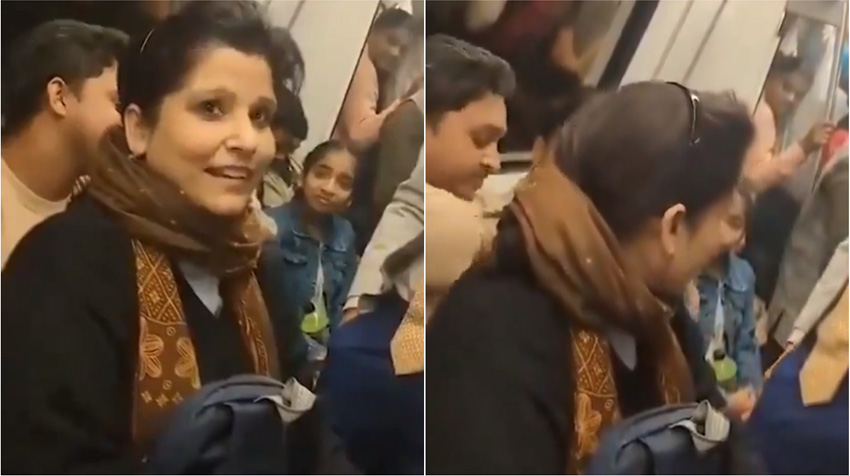
A viral video from the Delhi Metro has triggered widespread discussion across social media platforms after a woman was seen sitting on a man’s lap inside a crowded metro coach. The incident took a controversial turn when another passenger allegedly called the woman “besharam” (shameless), raising questions about public behavior, consent, moral policing, and overcrowding in public transport.
The video, which has now amassed thousands of views and shares, has divided public opinion and once again placed the Delhi Metro under the spotlight for passenger conduct and peak-hour congestion.
What Is Shown in the Viral Delhi Metro Video?
The viral clip reportedly shows a heavily crowded metro coach during rush hours. Due to lack of space, a woman is seen sitting on a male passenger’s lap while holding a nearby pole for support. The man appears uncomfortable but does not verbally object in the visible portion of the video.
#delhimetro
दिल्ली मेट्रो में महिला को सीट न मिली तो आदमी के गोद में बैठ गई। वीडियो हुआ वायरल pic.twitter.com/pTb7dMHAbQ— Yug (@mittal68218) April 21, 2024
Moments later, a fellow commuter confronts the woman and is heard calling her “besharam,” questioning her decision to sit on a stranger’s lap in a public place. The verbal exchange, partially captured on camera, quickly became the central point of controversy.
Social Media Reactions: Internet Divided
As with many Delhi Metro viral videos, public reaction has been sharply divided.
A section of social media users criticized the woman’s action, arguing that sitting on someone’s lap in public transport crosses social boundaries and disrupts public decorum. These users supported the passenger who confronted her, stating that such behavior should not be normalized in public spaces like the metro.
However, many others defended the woman, highlighting the severe overcrowding in Delhi Metro during peak hours. Supporters argued that the situation may not have been intentional or inappropriate but rather a consequence of limited space. Several users also questioned why the man’s consent was assumed and why the woman alone faced public shaming.
Overcrowding in Delhi Metro: The Real Issue?
Beyond the moral debate, the incident has reignited concerns about overcrowding in the Delhi Metro system. Despite being one of India’s most efficient urban transport networks, peak-hour congestion often leaves commuters with minimal personal space.
Urban transport experts point out that overcrowding frequently leads to uncomfortable physical proximity, which can sometimes result in misunderstandings or conflicts. Many online users argued that instead of blaming individuals, attention should be directed toward improving crowd management and increasing train frequency during rush hours.
Gender, Consent, and Moral Policing in Public Spaces
The use of the word “besharam” has also sparked a larger conversation about gender bias and moral policing. Critics argue that women are often judged more harshly for public behavior, while men involved in similar situations face little scrutiny.
Social commentators emphasized that if the man did not express objection, it was inappropriate for a third party to intervene using derogatory language. They also warned that public shaming can escalate tensions and create unsafe environments rather than resolving discomfort.
Delhi Metro Rules and Passenger Conduct
The Delhi Metro Rail Corporation (DMRC) has clear guidelines encouraging respectful behavior among passengers. While DMRC has not released an official statement regarding this specific viral video, it has previously advised commuters to avoid arguments and report issues to metro staff instead of engaging in confrontations.
In recent years, multiple viral incidents from Delhi Metro—ranging from public arguments to reel-making and physical altercations—have prompted DMRC to remind passengers that metro coaches are shared public spaces requiring mutual respect and cooperation.
Why Delhi Metro Videos Go Viral So Often
Delhi Metro has become a frequent backdrop for viral videos due to its massive daily footfall and diverse commuter base. With smartphones readily available, even minor incidents quickly gain traction online, often without full context.
Experts caution that viral clips can oversimplify complex situations, leading to one-sided narratives and online harassment of individuals involved.
Conclusion
The Delhi Metro viral video involving a woman sitting on a man’s lap and being called “besharam” is not just about public conduct—it reflects deeper issues of overcrowding, gender judgment, and moral policing in urban India. While maintaining decorum in public spaces is important, empathy and context are equally essential.
As the debate continues online, the incident serves as a reminder that better infrastructure, calm communication, and respect for personal dignity are crucial in shared public transport systems.
 Dianna
  Admin
Admin  Sanjay Mishra