
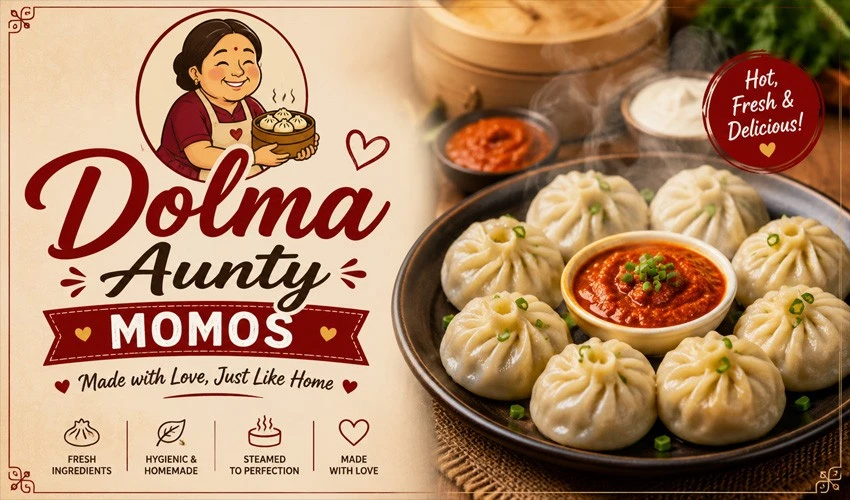
If you have ever walked through the bustling lanes of Lajpat Nagar’s Central Market in South Delhi, chances are you have caught a whiff of something irresistible — steam rising from bamboo baskets, the sharp tang of red chilli garlic chutney, and a crowd of eager food lovers gathered around a modest stall. Welcome to Dolma Aunty Momos, a name that has become synonymous with Delhi’s street food culture and, quite literally, the birthplace of the city’s momo revolution.
This is not just a story about dumplings. It is a story about courage, cultural migration, culinary artistry, and one remarkable Tibetan woman who dared to introduce an unfamiliar dish to a skeptical city — and won.
The Woman Behind the Legend: Who Is Dolma Aunty?
At the heart of this beloved institution is Dolma Tsering, a native of Tibet who moved to Delhi in 1990. Dolma Tsering moved to Delhi in 1990 after being married off and started her own stall in 1994. With limited resources, little Hindi, and an ambitious dream to earn a livelihood, she turned to the one thing she knew best — her homeland’s traditional recipe for momos.
Dolma Tsering after moving to Delhi in 1990 always aimed to do something to earn a living. After trying her hands in many jobs, she wasn’t satisfied at all, and the last option that was left to give it a try was to open a momo stall in Delhi.
The idea was daring. Delhi in the early 1990s was not a city that had experienced Tibetan dumplings. The concept of steamed food wrapped in flour dough was entirely alien to most North Indians who were accustomed to deep-fried chaat, spicy kebabs, and tandoor-baked bread. But Dolma Aunty pressed forward with nothing but a steamer, a recipe passed down through generations, and an unshakeable belief in her food.
1994: The Year That Changed Delhi’s Street Food Forever
Dolma Tsering, a native of Tibet, is believed to have started the first momo stall in Lajpat Nagar in 1994. When Dolma first arrived in Delhi in the ’90s, there were hardly any takers for momos among the locals as they thought the dish was raw in comparison to other street food.
The early days were painfully slow. Passersby would stop, stare, and walk away. Many looked at the pale, steamed parcels with suspicion. As Dolma herself has recounted, “I was the first one, there was no culture of momos in Delhi before me. They all looked at me suspiciously like — ‘Who is this woman selling this undercooked maida dish’. They didn’t know what momos were.”
She and her sister stood adamantly in the streets of Delhi with a hope that one day the idea would work. Language was another barrier — she barely spoke Hindi, making it difficult to explain the dish to curious but reluctant customers.
Initial days for Dolma Aunty were obstacle-ridden with no buyers, but with time and patience, her work speaks for itself. Slowly, one curious bite at a time, Delhi began to fall in love with the momo. Her chilli garlic chutney — freshly prepared each morning — became the game-changer. Its fiery, tangy kick complemented the soft, pillowy dumplings perfectly, and word spread fast.
In 1994, Dolma Aunty started out by selling a plate of six momos at rupees 15. Today, the same plate is priced very affordably, still accessible to students and office-goers alike, staying true to the democratic spirit of great street food.
Why Lajpat Nagar Was the Perfect Home
Dolma Aunty’s choice of Lajpat Nagar was no accident. Her location, Lajpat Nagar, was a fruitful one. The neighbourhood, one built after the Partition of India to accommodate incoming refugees from the newly formed Pakistan, is a centre of livelihood for many and is in a constant state of flux.
Tsering also notes that the market is a centre for recreation. Every day, millions hop off at Central Market to shop, eat and roam the neighbourhood, giving the momo an ample audience.
There is a poetic symmetry to this geography. Lajpat Nagar has always been a neighbourhood of newcomers, of people who arrived with little and built something meaningful. Dolma Aunty fit right into that ethos — a Tibetan refugee who transformed her culinary heritage into a cultural landmark.
The Menu: More Than Just Momos
While steamed momos remain the cornerstone of Dolma Aunty’s menu, the stall has evolved considerably over three decades. She sells steamed momos with three kinds of fillings — Veg Momos that come with a filling of grated carrot, cauliflower and onions served with chilli garlic chutney; Chicken Momos that come with a filling of minced chicken; and Paneer Momos served with a spicy chutney.
Beyond the classics, the menu today includes:
- Tandoori Momos — perhaps the most popular item among newer visitors, where steamed momos are charred in a tandoor and finished with cream and spices, creating a smoky, indulgent twist on the original.
- Fried Momos — crispy on the outside, juicy within, for those who prefer a little crunch.
- Afghani Momos — coated in a rich, creamy marinade, these are a crowd favourite that bridges Tibetan and Central Asian flavours.
- Kathi Rolls — a more recent addition to the menu that caters to the diverse palate of Lajpat Nagar’s shoppers.
- Softy Ice Cream and Cold Drinks — perfect accompaniments for Delhi’s scorching summers.
The stall serves momos, rolls, drinks, and softy, operating from 12:30 PM to 10:00 PM.
The chutneys, however, remain the soul of the experience. The chutneys are most loved by her loyal customers as she prepares them by her own early in the morning. The red chilli garlic chutney delivers a bold, pungent heat, while the white dip adds a cooling counterbalance — together, they are what many loyal customers say they come back for, again and again.
From a Single Stall to a Delhi Institution
What began as one woman with a steamer and a dream has grown into something much larger. Today, Dolma Aunty has three shops across Delhi with over 20 employees. While her son, Ramu, now manages the main business, she personally ensures that her traditional recipe is still used in all the outlets.
By the end of the day, there is not a single momo that is left unsold. That is a testament not just to demand, but to consistency — the hallmark of truly great street food.
The stall has also attracted an extraordinary range of visitors. Food bloggers, travel vloggers, journalists, and tourists from across India and the world make a point of stopping at Dolma Aunty’s when they visit Delhi. At Dolma Aunty Momos, a shop selling momos in central Delhi, crowds of hungry customers push to the front for a plate of dumplings in a day cloaked by deep summer heat.
The Bigger Picture: A Tibetan Legacy in Delhi
Dolma Aunty’s story cannot be told without acknowledging the broader Tibetan refugee experience in India. A safe estimate is that momos first arrived in Delhi when the Dalai Lama fled Tibet, along with millions of Tibetans who sought to escape the Chinese annexation of their homeland. Along with the refugees came momos.
Until the 1980s, the momo remained fairly obscure, sold in some corners of the city, sometimes found in restaurants catering to refugees — it was still considered a foreign dish, bound by the neglect and ghettoisation of the people that brought it.
Dolma Tsering changed all of that. By setting up her stall in one of Delhi’s most bustling commercial markets, she placed the momo in front of mainstream Delhi — and the city embraced it completely. Today, momos are arguably the most consumed street food in Delhi, available at every corner from Connaught Place to Chandni Chowk. And it all traces back, in no small measure, to one Tibetan woman in Lajpat Nagar.
Visiting Dolma Aunty Momos: What You Need to Know
- Location: D-01, Central Market, Lajpat Nagar 2, New Delhi – 110024 (near the Police Station on Alankar Cinema Road)
- Timings: 12:30 PM – 10:00 PM (Daily)
- Price Range: Affordable — starting from around ₹50 per plate, with a meal for two costing approximately ₹350.
- Best Time to Visit: Weekday afternoons are relatively quieter; weekends draw large crowds, so arrive early to avoid long waits.
- What to Order First: Start with the classic steamed veg or chicken momos with the signature red chutney. If you are feeling adventurous, the tandoori momos are a must-try.
- Tips: The queue moves fast, so do not be discouraged by the crowd. The momos are freshly steamed in batches, ensuring you always get them hot.
The Verdict: Is It Worth the Hype?
Dolma Aunty Momos have become a brand itself in past couple of years. For almost three decades, the taste has remained largely consistent, and the chutney continues to be celebrated as one of the finest accompaniments to momos in Delhi. Like any iconic food spot, opinions vary — some loyalists swear it is the best momo in the city, while others feel the growing popularity has affected consistency at times.
But beyond the plate, visiting Dolma Aunty Momos is about experiencing a living piece of Delhi’s culinary history. It is about sitting in a bustling market, watching steam curl from bamboo baskets, and eating something that connects you to a story far bigger than street food — a story of migration, resilience, and the extraordinary power of a single dish to bridge cultures.
Whether you are a first-time visitor to Lajpat Nagar or a lifelong Delhiite, a stop at Dolma Aunty’s is not optional. It is essential.
Dolma Aunty Momos — D-01, Central Market, Lajpat Nagar 2, New Delhi. Open daily, 12:30 PM to 10:00 PM.