
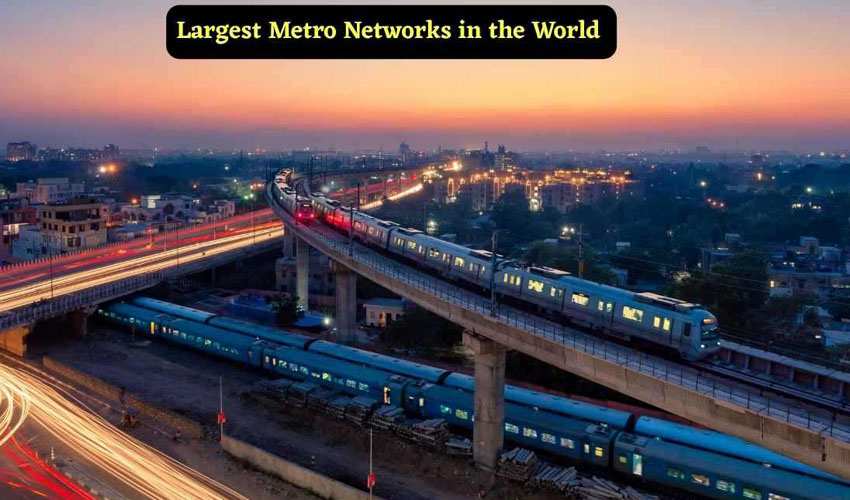
In an era defined by rapid urbanization and population growth, efficient mass transit has become essential for modern cities. Metro systems—electric, high-capacity urban rail networks—are the backbone of public transport in many megacities around the world. These systems not only reduce traffic congestion and pollution but also support economic activity by facilitating the movement of millions of commuters daily. The following article explores the top 10 largest metro networks in the world in terms of operational track length and network scale.
1. Shanghai Metro – China
Network Length: ~831 km
Stations: 508
Overview: The Shanghai Metro stands at the pinnacle of worldwide metro systems, making it the largest in the world. Since opening in 1993, this sprawling network has grown at an astonishing pace, now comprising more than 20 operational lines that weave through one of China’s most populous cities. Its sheer scale and coverage allow it to carry millions of passengers daily across a metropolitan landscape home to over 24 million people. The network’s expansion reflects China’s broader commitment to urban rail infrastructure.
2. Beijing Subway – China
Network Length: ~669.4 km (some sources count higher when including branch and service lines)
Stations: ~490
Overview: The Beijing Subway is not only among the world’s largest metro systems but also one of the busiest. First opened in the late 1960s, it has expanded dramatically over the past few decades to cover nearly the entire Beijing metropolitan region. With plans for continued expansion and extensions into suburban districts, the Beijing Subway is a cornerstone of daily life for commuters in China’s capital. Its vast scale also reflects decades of consistent investment in public transport.
3. London Underground – United Kingdom
Network Length: ~402 km
Stations: 272
Overview: Often affectionately called “the Tube,” the London Underground is the oldest metro system in the world, having opened in 1863. While it no longer holds the title for size, its historical significance and continuous adaptation make it one of the most iconic metro networks globally. The Tube’s extensive network spans the Greater London area and integrates with other transport services such as Overground, Docklands Light Railway, and commuter rail lines, providing seamless connectivity across the British capital.
4. Guangzhou Metro – China
Network Length: ~621 km
Stations: 302
Overview: The Guangzhou Metro in southern China’s Guangdong province is one of Asia’s most expansive and fastest-growing metro systems. Since its inception in 1997, it has rapidly expanded to serve a booming urban population with dozens of modern lines and a state-of-the-art fleet. Its layout includes both underground and elevated segments, ensuring accessibility across a sprawling urban region known for its economic dynamism.
5. New York City Subway – United States
Network Length: ~399 km
Stations: 472
Overview: The New York City Subway is the largest metro system in the United States and one of the most extensive in the world by number of stations. Opened in 1904, it operates 24 hours a day, 7 days a week—a rarity among global metro systems. Its coverage spans four of New York’s five boroughs, serving as the lifeblood of daily urban mobility for millions. Although its track length is shorter than some Asian counterparts, its high station count and nonstop service operations make it a global transit icon.
6. Delhi Metro – India
Network Length: ~350.4 km
Stations: 256 (varies with new phases)
Overview: The Delhi Metro has transformed urban transit in India’s capital region. Since its first operations in 2002, it has expanded rapidly across Delhi and its neighboring cities like Noida, Gurgaon, Ghaziabad, and Faridabad. Known for its punctuality, cleanliness, and architectural design, the Delhi Metro serves as a model for mass transit development in India and other developing economies. Its expansion continues in multiple phases, promising better connectivity across the National Capital Region.
7. Moscow Metro – Russia
Network Length: ~525.8 km (note: some global lists differ in ranking metrics)
Stations: ~300
Overview: The Moscow Metro is not just one of the largest in the world but also one of the most beautiful. Opened in 1935, it is famous for its ornate station architecture—often described as “underground palaces.” Serving both the city and extended metropolitan area, this metro combines extensive coverage with high capacity. It is considered the busiest metro outside of Asia and remains an integral part of daily life in Russia’s capital.
8. Wuhan Metro – China
Network Length: ~518 km
Stations: 312
Overview: Wuhan Metro is among China’s fastest-growing systems. It serves the central city of Wuhan in Hubei province and has expanded significantly since its launch in 2004. Characterized by a mix of underground and elevated lines, this network efficiently connects multiple urban districts, helping to manage traffic demand and support regional development. Its continued expansion reflects Wuhan’s emergence as a major economic and transport hub in central China.
9. Seoul Metro – South Korea
Network Length: ~340.4 km
Stations: ~315
Overview: The Seoul Metro system, serving South Korea’s capital and surrounding regions, is one of Asia’s most advanced and heavily used urban transit networks. Featuring modern rolling stock, advanced signaling systems, and high frequency service, Seoul Metro is renowned for its efficiency and passenger comfort. Integrated with multiple other rail services in the metropolitan region, the network plays a critical role in daily commuter travel and urban mobility.
10. Madrid Metro – Spain
Network Length: ~293 km
Stations: 302+
Overview: The Madrid Metro rounds out the top 10 as the largest metro network in Spain and one of the longest in Europe. Established in 1919, it has grown steadily over more than a century to serve the Spanish capital and surrounding suburbs. The network’s conventional heavy rail lines and light rail extensions together provide extensive urban coverage, making Madrid Metro essential for daily commuting and tourism alike.
Why Metro Systems Matter
Metro networks are foundational to modern cities for several reasons:
1. Urban Mobility and Accessibility
Metro systems enable rapid movement across large metropolitan areas. They reduce travel time significantly and offer commuters a reliable alternative to congested roads.
2. Environmental Sustainability
By shifting commuters from private vehicles to electric rail, metros help cut greenhouse gas emissions and pollution—an essential benefit in densely populated cities.
3. Economic Growth and Development
Efficient transit supports employment, commerce, and real estate development. Metro accessibility often stimulates economic activity around stations and along transit corridors.
4. Quality of Life Enhancements
Well-developed metro systems improve quality of life by making cities more navigable and equitable. They ensure that residents from various income levels and neighborhoods can access key urban services.
Conclusion
As urban populations continue to grow, metro systems are set to become even more vital. The top 10 largest metro networks—from Shanghai and Beijing in China to London, New York, and Delhi—illustrate the global reliance on rapid transit to move billions of people efficiently across dense urban landscapes. These systems are not just transport infrastructures; they are lifelines that shape how cities live, work, and grow.
 Admin
Admin  Suman Gupta