
Introduction
Hidden in plain sight within the concrete chaos of Connaught Place, Agrasen Ki Baoli stands as one of Delhi’s most enigmatic monuments. Tucked away on a narrow lane off Hailey Road, this ancient stepwell feels like a secret the city keeps reluctantly — a deep, dark corridor descending into stillness while the modern world rushes past overhead. Neither entirely forgotten nor ever truly celebrated, Agrasen Ki Baoli occupies a strange middle ground between archaeology and mythology, between history and ghost story. To visit it is to step out of time.
What Is a Baoli?
Before understanding Agrasen Ki Baoli specifically, it helps to appreciate what a baoli — or stepwell — actually is. Unique to the Indian subcontinent, stepwells were ingenious architectural solutions to water scarcity in arid regions. Unlike conventional wells accessed by rope and bucket, a baoli featured a long descending staircase flanked by galleries, pillars, and ornamental chambers, allowing people to walk down to the water level as it rose and fell with the seasons. They served as community gathering spaces, resting points for travellers, and in many cases, sites of religious and spiritual significance. Agrasen Ki Baoli is among the finest surviving examples of this architectural tradition in North India.
Historical Background: Who Built It?
This is where the mystery begins. The origins of Agrasen Ki Baoli are genuinely uncertain. According to popular legend, it was originally constructed by the legendary King Agrasen — the mythological ancestor of the Agrawal community and a figure believed to have ruled during the Mahabharat era, thousands of years ago. However, historians and archaeologists point out that the existing structure, based on its architectural style, most likely dates to the 14th or 15th century — probably rebuilt or significantly renovated during the Tughlaq or early Lodi dynasty period of the Delhi Sultanate.
The Archaeological Survey of India (ASI), which now maintains and protects the site, has listed it as a protected monument, though even official records acknowledge that no clear historical inscription has been found to definitively identify the builder. This absence of documentation gives the site an aura of quiet ambiguity that only deepens its allure. Was there an older structure beneath the current one? Did a medieval ruler restore a far more ancient well in the name of the legendary king? These questions remain unanswered, which is perhaps exactly why Agrasen Ki Baoli continues to fascinate.
Architectural Marvel: The Design
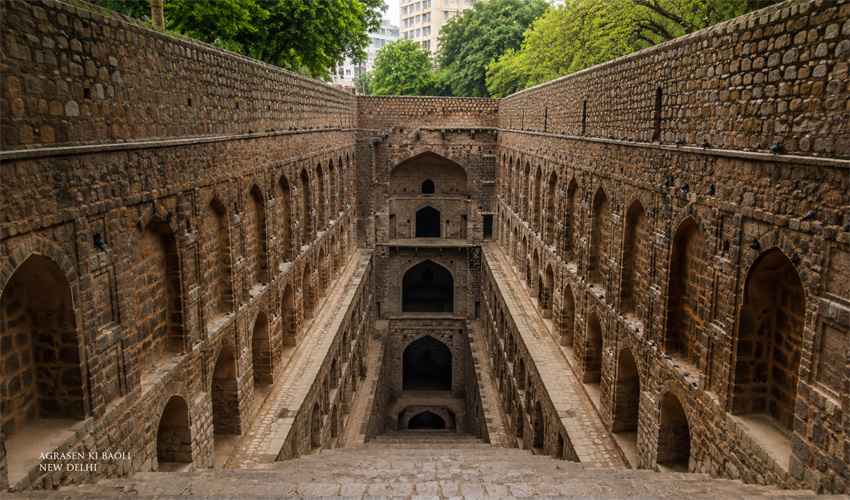
The stepwell stretches approximately 60 metres in length and 15 metres in width — modest by the standards of some of Rajasthan’s grand baolis, yet deeply impressive in its proportions and atmosphere. It descends through 108 steps arranged across three distinct levels or terraces, each flanked by a series of arched niches and small chambers that once served as resting alcoves for travellers and pilgrims.
The architecture blends elements of the Indo-Islamic style, with pointed arches lining the walls at regular intervals, creating a hypnotic visual rhythm as you descend. The further down you go, the more the arches seem to lean inward, the corridor narrows, and the temperature noticeably drops. Natural light diminishes gradually, replaced by a cool, dim stillness. At the lowest level, a now-dry well marks the original water source — the baoli has been dry for several decades, which only adds to its haunted, suspended quality.
The stonework, though weathered, remains remarkably intact. The uniformity of the arched galleries gives the impression of an infinite corridor in both directions when photographed from the right angle — a composition that has made Agrasen Ki Baoli a favourite subject among photographers and filmmakers across India.
The Paranormal Legends
No discussion of Agrasen Ki Baoli is complete without acknowledging the ghost stories. The stepwell carries a dark reputation in Delhi’s urban folklore. One of the most persistent legends claims that the black water once filling the well possessed a hypnotic power — that travellers who gazed too long into its depths were compelled by an unseen force to leap in, never to return.
Over the years, various paranormal investigators, YouTube ghost-hunters, and thrill-seeking visitors have contributed to a growing mythology around the site. Stories of unexplained sounds, cold spots, shadowy figures in the lower chambers, and a general feeling of being watched have circulated widely online. The Bollywood film Aiyyaa (2012) and the horror anthology Rahasya have used the baoli’s atmospheric setting to amplify its eerie reputation.
Whether one believes in the supernatural or not, the architecture itself creates a genuine psychological effect. The descending staircase, the narrowing walls, the absolute silence at the bottom, the sense of being below the city — it all combines to make Agrasen Ki Baoli feel genuinely unsettling, even in broad daylight. It is one of those rare places where the ambience alone is enough to make the hair on your neck stand up.
Cultural and Social Significance
Beyond mystery and myth, Agrasen Ki Baoli represents something culturally vital: a reminder of how pre-modern Indian societies managed water sustainably and communally. Stepwells were not merely utilitarian — they were democratic spaces where people of various social strata gathered, rested, and interacted. The architectural investment in beauty — the carved niches, the symmetrical arches, the careful stonework — reflects a civic philosophy that treated public infrastructure as worthy of artistic attention.
For the Agrawal community specifically, the baoli holds deep cultural and ancestral meaning, as it is linked to the veneration of King Agrasen as a founding patriarch. Periodic events and commemorations at the site are organised by community organisations, adding a living layer of cultural practice to what could otherwise remain merely a stone relic.
Agrasen Ki Baoli in Popular Culture
The stepwell’s dramatic geometry and brooding atmosphere have made it irresistible to the creative world. It has appeared in numerous Bollywood productions, music videos, fashion editorials, and travel documentaries. Its image — the long descending staircase flanked by perfect arches disappearing into shadow — has become one of the most recognisable heritage photographs from Delhi, widely shared on Instagram and travel blogs.
This media visibility has been a double-edged sword. While it has brought well-deserved attention to a site that might otherwise remain overlooked, it has also brought crowds, noise, and the inevitable challenges of managing tourism at a fragile historical monument.
Visiting Agrasen Ki Baoli: Practical Information
Agrasen Ki Baoli is located on Hailey Road, near KG Marg in central Delhi, making it easily accessible from Connaught Place — one of the city’s main commercial hubs. The nearest metro station is Barakhamba Road on the Blue Line, just a short walk away.
Entry to the monument is free of charge, and it is open from sunrise to sunset on all days of the week. Photography is permitted, which makes it a popular destination for both tourists and hobbyist photographers. The ASI maintains basic upkeep, though the site has no elaborate amenities — no museum, no audio guide, no souvenir shop. It is simply the monument, a few informational boards, and the quiet.
The best time to visit is either early morning, before the tourist footfall builds up, or late afternoon, when the light falls diagonally across the arches and the city’s noise is muffled by the stone walls. Monsoon season gives the site a particularly atmospheric quality, though the steps can become slippery and must be navigated carefully.
Conclusion
Agrasen Ki Baoli is not the grandest monument in Delhi, nor the most visited. But it may well be the most evocative. It carries within its stones a layered identity — part legend, part history, part ghost story, part architectural masterpiece. It is a place that rewards the curious visitor who wanders off the tourist trail, descends its 108 steps away from the city’s noise, and allows themselves a few quiet minutes at the bottom to sit with the mystery of it all.
In a city as ancient and overwhelming as Delhi, that kind of stillness is its own kind of magic.