
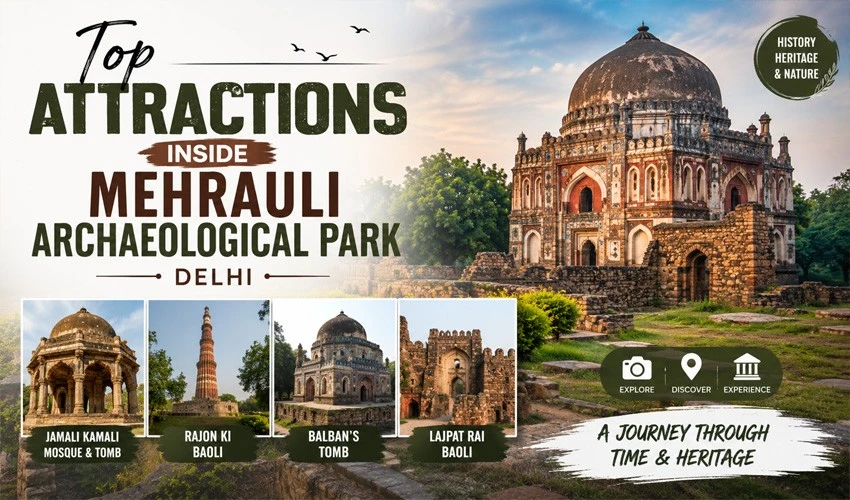
Tucked away right beside the Qutub Minar complex in South Delhi, the Mehrauli Archaeological Park is one of the city’s most underrated heritage destinations. Spread across roughly 80–100 acres of forested land, this open-air park is home to more than 100 monuments — some meticulously restored, others quietly crumbling under centuries of history. Unlike Delhi’s more famous monuments that draw huge crowds, Mehrauli Archaeological Park offers a peaceful, almost secret journey through the Delhi Sultanate, Mughal era, Lodi period, and even the British colonial years, all within a single walking trail.
If you’re planning a visit, here’s a detailed look at the must-see attractions inside the park, along with practical tips to help you explore it well.
A Quick Introduction to the Park
Mehrauli holds the distinction of being one of the oldest continuously inhabited areas in Delhi, with a history stretching back over a thousand years. As different dynasties — the Slave Dynasty, Khalji, Tughlaq, Lodi, and later the Mughals — rose and fell, each left behind its own architectural imprint in this pocket of South Delhi. The Archaeological Survey of India (ASI) eventually consolidated many of these scattered ruins into what is now called the Mehrauli Archaeological Park, making it one of the few places in the world where you can walk through nearly a millennium of continuous architectural history in a single afternoon.
Entry to the park is free, and it’s typically open daily from around 6 AM to 6 PM, making early mornings or late afternoons the best time to visit for pleasant weather and good light for photography.
1. Balban’s Tomb
As you enter the park from the side closer to Qutub Minar, one of the first structures you’ll encounter is the Tomb of Ghiyasuddin Balban, a 13th-century Sultan of the Slave Dynasty. Though largely in ruins today, with only fragments of walls still standing, this tomb holds enormous historical significance. It’s considered to house India’s first true arch and dome, marking a major shift in Indo-Islamic architecture away from earlier corbelled construction techniques. Historians and architecture enthusiasts often consider this humble ruin more important than its outward appearance suggests.
2. Jamali Kamali Mosque and Tomb
Perhaps the most well-preserved and visually striking structure in the park, the Jamali Kamali Mosque and Tomb complex dates back to 1528–1529. It comprises a mosque built in classic Lodi-Mughal transitional style, along with the tomb of the Sufi saint-poet Sheikh Fazlullah, popularly known as Jamali, and his companion Kamali, about whom far less is known. The interiors of the tomb are richly decorated with intricate stucco work, painted ceilings, and Quranic inscriptions, making it one of the most photogenic spots in the entire park.
3. Quli Khan’s Tomb (Dilkhusha)
Not far from Jamali Kamali stands the Tomb of Muhammad Quli Khan, brother of the powerful Mughal courtier Adham Khan. Built in the 16th century, this tomb later found an unusual second life — during British rule, it was converted into a country residence known as “Dilkhusha” by Sir Thomas Metcalfe, a British official who had a deep fascination with Mehrauli’s ruins. Metcalfe added several eclectic touches to the structure, blending Mughal-era architecture with colonial sensibilities, which makes this tomb a curious study in cross-cultural adaptation.
4. Rajon ki Baoli (Step Well)
Widely regarded as Delhi’s finest and best-preserved stepwell, Rajon ki Baoli dates back to the early 16th century, during the Lodi period. The multi-tiered structure descends several storeys below ground level, lined with arched corridors, decorative pillars, and small chambers that were likely used for rest and relaxation during the harsh Delhi summers. A small mosque and a domed tomb stand adjacent to the baoli, together forming one of the most architecturally complete clusters in the park. The play of light and shadow across its stepped corridors makes it an especially rewarding stop for photographers.
5. Adham Khan’s Tomb
Standing at the northern edge of Mehrauli village, this imposing octagonal tomb belongs to Adham Khan, a general and foster brother of Emperor Akbar, who was executed on Akbar’s orders after a court conspiracy. Built around 1562, the structure has had a fascinatingly varied afterlife — at different points in history, it served as a British residence, a police post, and even a post office, before eventually being restored to its original form. Locals sometimes refer to it as “Bhool Bhulaiyan” (the maze) because of its confusing internal passageways.
6. Jahaz Mahal (Ship Palace)
One of the more elegant structures in the park, Jahaz Mahal gets its name — meaning “Ship Palace” — from its reflection in the adjacent Hauz-i-Shamsi reservoir, which historically made the building appear to float like a ship. Built during the Lodi era, this pavilion is believed to have served as a resting place for pilgrims travelling to various Sufi shrines in the area, or alternatively as a royal pleasure retreat. Its arched facades, chhatris (domed pavilions), and decorative merlons make it one of the most architecturally graceful buildings in the park.
7. Hauz-i-Shamsi
Adjacent to Jahaz Mahal lies the Hauz-i-Shamsi, an artificial reservoir originally constructed in 1230 by Sultan Iltutmish. According to popular legend, the site was chosen because the Sultan dreamt of the Prophet’s horse touching the ground here, marking the spot as sacred. While much smaller today than its original size, the reservoir remains an important historical water body and a peaceful spot to pause during your walk through the park.
8. Dargah of Qutab Sahib
To the south of Mehrauli village lies the Dargah of Khwaja Qutbuddin Bakhtiyar Kaki, a revered 13th-century Sufi saint after whom the Qutub Minar is believed to be named. This white marble shrine remains an active place of worship even today, drawing devotees of multiple faiths. Unlike most of the other ruins in the park, this dargah is a living monument, complete with regular prayers, offerings, and a steady stream of visitors, giving you a glimpse into how Mehrauli’s spiritual traditions have continued unbroken for centuries.
9. Zafar Mahal
Located near the Dargah, Zafar Mahal was the last significant addition to Mughal architecture in Delhi, built as a summer retreat for the royal family. It’s named after Bahadur Shah Zafar, the last Mughal emperor, who intended to be buried here (though he ultimately died in exile in Rangoon and was buried there instead). The grand gateway of Zafar Mahal, known as Hathi Gate, remains one of its most striking surviving features.
10. Madhi Masjid
A relatively lesser-known but architecturally interesting structure, Madhi Masjid is a Lodi-era mosque tucked within the park’s greener stretches. Its restrained, elegant design reflects the transitional architectural style of the period, bridging earlier Tughlaq austerity with the more ornamental Mughal style that followed.
11. Metcalfe’s Folly and Other British-Era Additions
Scattered through the park are several structures added or modified during British rule, most notably by Sir Thomas Metcalfe, who was captivated by Mehrauli’s ruins and repurposed several tombs as follies, guest houses, and decorative additions to his estate. These structures serve as an interesting reminder of how colonial-era Delhi engaged with — and sometimes reshaped — its own medieval past.
12. Hijron ka Khanqah
An often-overlooked but historically significant site within the park, Hijron ka Khanqah is a Sufi hospice dating back to the Lodi dynasty. It was historically associated with providing shelter and spiritual community to Delhi’s transgender population, making it a rare and culturally important marker of inclusion within India’s medieval religious institutions.
Tips for Exploring Mehrauli Archaeological Park
- Time needed: A relaxed walk covering the major monuments typically takes about 3–4 hours. If you’re short on time, prioritise Jamali Kamali, Rajon ki Baoli, Jahaz Mahal, and Balban’s Tomb.
- Best time to visit: Early mornings or late afternoons, especially between October and March, when Delhi’s weather is more pleasant for walking.
- What to carry: Comfortable walking shoes, water, a hat or cap, and a camera — many pathways are uneven, and shade can be limited in certain stretches.
- Guided tours: Since signage inside the park is minimal, hiring a local heritage guide or joining a guided walking tour can significantly enrich your visit by adding context and stories to what would otherwise look like unlabelled ruins.
- Combine with nearby sights: Since the park sits right next to the Qutub Minar complex, it’s easy to combine both visits in a single outing.
Final Thoughts
Mehrauli Archaeological Park is one of those rare places in Delhi where history hasn’t been over-polished for tourists — it still feels raw, quiet, and genuinely old. Walking through its tombs, mosques, stepwells, and pavilions offers a far more intimate encounter with Delhi’s layered past than most conventional monuments can provide. Whether you’re a history enthusiast, a photographer, or simply someone looking for a quiet escape from the city’s usual crowds, this park rewards a slow, curious visit.