
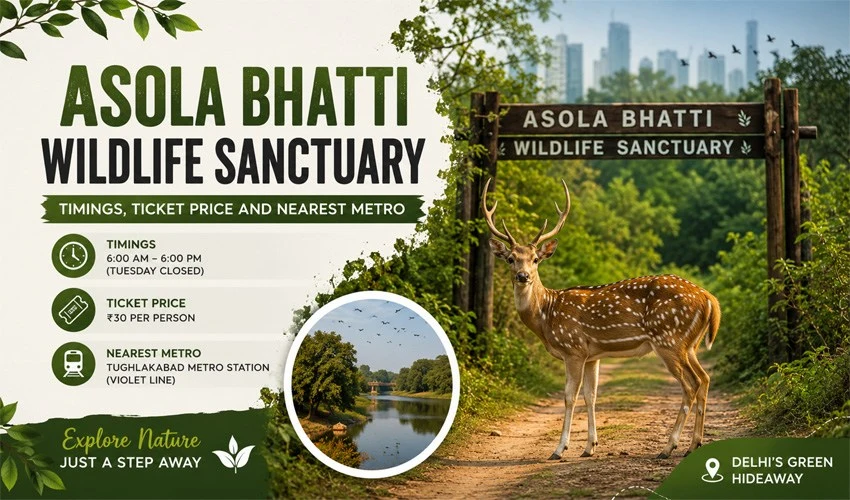
Tucked away in the rocky folds of the Aravalli hills, on the southern edge of the capital, Asola Bhatti Wildlife Sanctuary is one of Delhi’s best-kept secrets. While most visitors to Delhi head straight for Qutub Minar, India Gate, or Humayun’s Tomb, this quiet stretch of scrub forest offers something entirely different — a genuine slice of wilderness within touching distance of the city’s traffic and concrete. For birdwatchers, nature photographers, trekkers, and anyone simply looking to escape the urban grind for a few hours, Asola Bhatti is a rewarding destination. This guide covers everything you need to know before you go, including timings, ticket prices, the nearest metro stations, and practical tips to make your visit smooth.
About Asola Bhatti Wildlife Sanctuary
Spread across the rugged terrain where Delhi meets Haryana, Asola Bhatti Wildlife Sanctuary was notified in 1986 and today extends over thousands of acres of Aravalli scrubland. It holds a unique ecological distinction: it is the only protected area in India’s national network that represents the northeastern outliers of the Aravalli range, making it geographically significant beyond just its local charm.
The landscape here isn’t the lush, green jungle many people imagine when they hear “wildlife sanctuary.” Instead, it’s a dry, rocky, semi-arid habitat, dotted with thorny scrub, seasonal streams, and old abandoned mining pits that have gradually been reclaimed by nature — including a picturesque quarry lake locally known as Neeli Jheel, or the Blue Lake. This transformation from a mined, degraded landscape into a thriving ecological zone is itself one of the sanctuary’s most compelling stories.
Despite its arid appearance, the sanctuary supports a surprisingly rich variety of life. It’s home to nilgai (blue bull), jackals, civets, mongooses, and several species of snakes, along with an impressive checklist of over a hundred bird species and dozens of butterfly varieties. For birders, this makes Asola Bhatti one of the most rewarding spots near Delhi, especially during the cooler months when migratory birds pass through.
The Bombay Natural History Society (BNHS) has also set up a Conservation Education Centre within the sanctuary, in partnership with the Delhi government’s Forest Department. They regularly organize nature walks and awareness sessions, which are a great way for first-time visitors to learn about the local ecology from people who know the terrain well.
Asola Bhatti Wildlife Sanctuary Timings
One thing to keep in mind before planning your trip is that timing information for Asola Bhatti varies slightly across different sources, so it’s worth double-checking closer to your visit date, especially if you’re planning a trip around a specific trail or guided walk.
Generally, the sanctuary is open through the morning and early afternoon hours, broadly falling somewhere in the range of 6:00 AM to 5:00 PM depending on the season and the specific gate or trail you’re using. Early morning hours — particularly between 6:00 AM and 9:00 AM — are considered the best window for both bird activity and pleasant weather, especially if you’re visiting between October and March.
A few points worth noting:
- The sanctuary typically observes a weekly closure, though sources differ on whether this falls on Mondays or on the weekend. It’s best to call ahead or check with the local forest office before heading out, particularly if you’re travelling from far.
- Guided nature walks organized by BNHS or the forest department usually run on specific mornings and may require prior booking or intimation.
- Visiting hours can shift slightly with the seasons — daylight hours are shorter in winter, so gates may close earlier.
- If you’re planning to explore one of the marked birding trails, it’s a good idea to start as early as possible to have enough daylight for the full route and to catch birds at their most active.
Because official timing details are subject to change and vary by source, calling the sanctuary’s ticket inquiry number before your visit is a smart, low-effort way to avoid disappointment.
Ticket Price and Entry Fee
Here’s some good news for budget travelers and casual nature lovers: entry to Asola Bhatti Wildlife Sanctuary is largely free or available at a nominal cost, unlike many of Delhi’s paid heritage sites and monuments. Some listings mention no entry fee at all for simply walking through the sanctuary grounds, while others list a modest token fee for adults and children — so pricing details can vary depending on which gate or trail you use, and whether you’re joining an organized activity.
If you’re planning to join a guided nature walk, workshop, or a special programme run by BNHS or the forest department, there may be a separate nominal charge for that specific activity, which is different from general entry. Photography enthusiasts carrying professional camera equipment or planning drone use should also check in advance, as additional permissions or charges sometimes apply for such equipment inside protected forest areas.
Given the mix of information available online, our recommendation is straightforward: carry some cash in small denominations just in case, and confirm the latest fee structure with the ticket counter or the sanctuary’s official contact number before finalizing your travel plans. This ensures you’re not caught off guard, and it also supports the conservation work being carried out on the ground.
Nearest Metro Station to Asola Bhatti Wildlife Sanctuary
Given its location along the Delhi–Haryana border, near Tughlakabad and close to the Surajkund road, Asola Bhatti is reasonably well connected by Delhi Metro, though the sanctuary itself isn’t right next to a station — some last-mile travel by auto-rickshaw or cab is usually needed.
The metro stations most commonly used to reach the sanctuary include:
- Tughlakabad Metro Station (Violet Line) — generally considered the closest and most convenient option for most visitors coming from central or south Delhi.
- Badarpur Metro Station (Violet Line) — another practical option, especially if you’re coming from areas further along the Violet Line corridor.
- Sarai Metro Station (Violet Line)
- Mohan Estate Metro Station (Violet Line)
- Sarita Vihar Metro Station (Violet Line)
All of these stations sit on the Violet Line and are located within a roughly similar driving distance from the sanctuary gates. From any of these stations, you’ll need to take an auto-rickshaw, cab, or app-based ride to actually reach the sanctuary entrance, since the last stretch isn’t walkable for most visitors, particularly in Delhi’s summer heat.
If you’re travelling by car, the sanctuary is accessible via Shooting Range Road, off Suraj Kund Road, making it a fairly easy addition to a day trip that also includes Surajkund or the Aravalli Biodiversity Park.
Best Time to Visit Asola Bhatti Wildlife Sanctuary
Delhi’s climate swings dramatically between seasons, and this has a big impact on how enjoyable your visit to Asola Bhatti will be.
Winter (October to March) is widely considered the best time to visit. Temperatures are mild, migratory birds are present in large numbers, and walking the trails is far more comfortable than during the peak of summer. Early mornings during these months often bring a light mist over the scrubland, adding to the sanctuary’s quiet, contemplative atmosphere.
Summer (April to June) can be extremely harsh, with daytime temperatures often crossing 40°C. If you must visit during this period, plan to arrive right at opening time and finish your walk before the midday heat sets in.
Monsoon (July to September) brings a burst of greenery to the otherwise dry landscape, and the seasonal streams and the Neeli Jheel fill up, making for a scenic change. However, trails can get slippery, and humidity levels rise sharply, so sturdy footwear and caution are advised.
Tips for Visitors
A few practical suggestions to help you make the most of your trip:
- Wear comfortable, sturdy shoes — the terrain is rocky and uneven in several stretches.
- Carry water and sun protection, since shaded areas are limited across the scrubland.
- Bring binoculars if birdwatching is a priority; many of the sanctuary’s bird species are best spotted at a distance.
- Avoid loud noises and sudden movements, especially near water bodies where wildlife tends to congregate.
- Check ahead for any guided walk schedules if you’d like a more informed experience of the flora and fauna.
- Since mobile network coverage can be patchy in certain interior stretches, inform someone of your plans and carry a fully charged phone.
Final Thoughts
Asola Bhatti Wildlife Sanctuary is proof that you don’t need to travel far from a major metropolitan city to find genuine wilderness. Its rocky Aravalli terrain, reclaimed mining pits turned into a scenic lake, and surprisingly diverse birdlife make it a rewarding half-day trip for anyone in Delhi looking for a change of pace. Because timing and ticketing details can vary depending on the season and source, it’s always worth a quick call to the sanctuary before you head out — but once you’re there, the peaceful trails and open skies make the little bit of planning entirely worth it.