
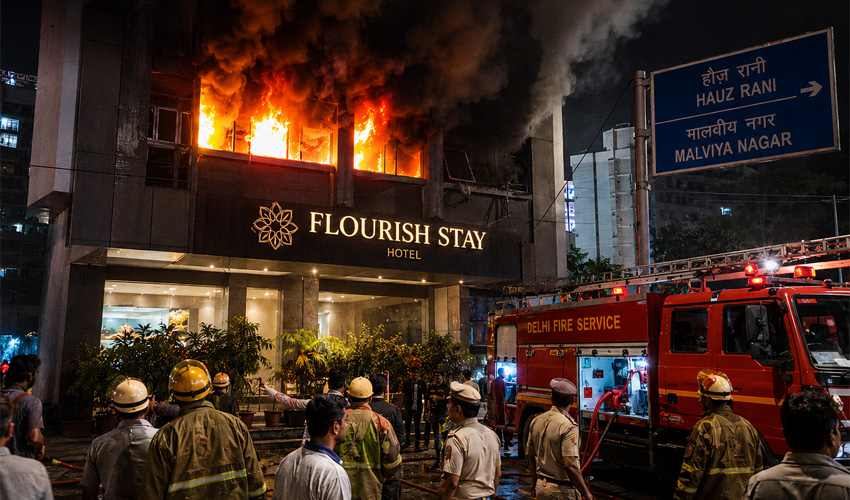
In the early morning hours of Wednesday, June 4, 2026, a fire tore through a five-storey bed-and-breakfast hotel in one of South Delhi’s most congested neighbourhoods — and by the time the smoke cleared, 21 people lay dead. The Flourish Stay B&B, nestled in the narrow lanes of Hauz Rani village in Malviya Nagar, was not just the scene of a catastrophic blaze — it was a building riddled with violations, shortcuts, and a criminal disregard for human life.
The tragedy has shaken the national capital to its core, reignited long-standing concerns about fire safety standards in Delhi’s budget hospitality sector, and prompted the Delhi government to launch a sweeping review of its Bed and Breakfast (B&B) licensing policy. Here is everything you need to know about what happened, who was responsible, and what it means for the future of hotel safety in India’s capital.
The Fire: What Happened on the Morning of June 4
The blaze was first reported to Delhi Fire Services at approximately 8:48–8:50 AM, when thick black smoke began billowing out of the Flourish Stay B&B hotel, located in a narrow, congested lane of the Hauz Rani locality of Malviya Nagar. DCP South Anant Mittal confirmed the exact time of the emergency call as 8:48 AM.
Within minutes, the five-storey building was engulfed. Flames shot through the structure with terrifying speed, aided by poor ventilation, cramped rooms, and a building layout that made escape nearly impossible for those trapped inside. More than 40 people were rescued and rushed to nearby hospitals — but 21 of them were declared dead on arrival or shortly after.
The cause of the fire is still under investigation, though a short circuit is widely suspected as the trigger. What is not in doubt is the catastrophic chain of negligence that turned a controllable incident into a mass casualty event.
The Victims: Foreigners Far From Home
Of the 21 people who perished in the Flourish Stay fire, 18 were foreign nationals. Victims came from Nigeria, Mozambique, Somalia, Liberia, Bangladesh, and Afghanistan — a heartbreaking cross-section of people who had travelled to Delhi largely to accompany family members receiving treatment at the nearby Max Super Specialty Hospital.
The Hauz Rani–Malviya Nagar area has long been a hub for budget accommodation for international patients’ attendants visiting Max Hospital. These families — already under immense emotional and financial strain due to medical emergencies — chose the Flourish Stay for its proximity to the hospital and its affordable rates. They could not have known that the building they were sleeping in was a firetrap.
Around 10 Delhi Police personnel were also injured during rescue operations, as they rushed into the smoke-filled building to pull survivors to safety.
A Building Full of Violations
Perhaps the most disturbing aspect of the Flourish Stay fire is not that it happened — but that it was entirely preventable. Investigators who combed through the property in the aftermath uncovered a staggering catalogue of safety failures and regulatory breaches.
No Fire Safety NOC
The hotel was operating without a valid Fire Safety No Objection Certificate (NOC), which is a mandatory requirement for all commercial hospitality businesses under India’s National Building Code. Operating without this clearance means the property had never been formally assessed for fire preparedness, escape routes, or suppression systems.
One Exit, No Escape
The building had only a single entry and exit route. When the fire broke out, this sole passage quickly filled with smoke, cutting off the escape path for dozens of guests. Investigators also found a locked iron grill in the basement, which further blocked movement and severely hampered rescue efforts.
Rooms Beyond Reason
The Flourish Stay held a licence under the Delhi government’s Bed and Breakfast scheme in the Silver Category, issued in 2024 and valid until 2027. That licence permitted the operation of just six rooms, with a maximum cap of eight. Authorities discovered the property had been expanded to operate 25 to 26 rooms — more than four times the permitted number. Some of these rooms had been constructed in the basement, where occupants had virtually no means of escape in an emergency.
The Deadly Basement
A restaurant and commercial operations were also being run from a cramped and poorly ventilated basement — a severe code violation. When fire and smoke filled the lower floors, anyone in the basement faced near-certain death. The locked iron grill found there made escape impossible and delayed rescue workers from reaching victims in time.
Congested Lanes and Overhead Hazards
The location itself compounded the disaster. The building sits in a narrow lane lined with overhead high-voltage electrical cables. These conditions created major logistical challenges for fire engines and delayed the deployment of firefighting equipment, precious minutes in which the blaze continued to spread.
The Owner: Lavkesh Bajaj Arrested
Hotel co-owner Lavkesh Bajaj had reportedly evaded authorities in the immediate aftermath of the fire, prompting Delhi Police to issue a Look-Out Circular (LOC) against him. He was eventually arrested on the evening of Wednesday, June 4, hours after the tragedy unfolded.
During questioning, Bajaj admitted to illegally expanding the number of rooms in the property from the permitted 6 to approximately 25, doing so to increase rental revenue. He also admitted that he did not personally oversee the day-to-day operations of the hotel and had delegated management to staff members.
Delhi Police registered an FIR against Bajaj under charges of culpable homicide not amounting to murder, along with other sections related to safety violations. He was produced before a court and remanded to four days of police custody for further questioning.
Municipal Corporation of Delhi (MCD) officials further alleged that Bajaj had obtained the B&B licence by concealing key facts about the premises, including the true number of rooms and the basement commercial activity.
It also emerged that Bajaj operates several other guesthouse and hotel properties in the broader Hauz Rani–Malviya Nagar area, all of which are now under the lens of investigators.
Government Response: Accountability and Policy Overhaul
The scale of the tragedy provoked swift political and administrative action at the highest levels.
Prime Minister Narendra Modi expressed grief over the loss of lives and announced an ex-gratia payment of ₹2 lakh each to the next of kin of the deceased and ₹50,000 for those injured.
Delhi Chief Minister Rekha Gupta ordered a magisterial inquiry into the fire and promised a city-wide crackdown on illegal properties, unauthorised guesthouses, and establishments operating in violation of fire safety norms. “Those responsible for this tragedy will be held accountable,” the CMO stated.
Tourism Minister Kapil Mishra announced that the Delhi government has decided to withdraw its existing Bed and Breakfast policy and conduct a comprehensive review of all establishments granted licences under the scheme. A new B&B Policy 2026 is being drafted with updated regulations.
The Revenue Department launched a survey of the Hauz Rani area to identify other potential safety and regulatory violations in the neighbourhood.
The Blame Game: Who Failed?
In the aftermath, a blame game has erupted between the police, the Municipal Corporation of Delhi, the Tourism Department, and other agencies.
MCD sources claimed that the Flourish Stays Hotel was not under their jurisdiction because it was ‘Lal Dora’ property — a classification for land in certain urban villages that falls outside normal municipal regulations. This legal ambiguity, they argued, meant the MCD could not have taken action against the property. MCD also claimed it was unaware of the restaurant operating from the basement.
Police, meanwhile, are reconstructing the sequence of events, questioning hotel staff, local residents, and collecting forensic evidence.
This institutional finger-pointing, tragically, is not new in India’s history of hotel fires. The 2019 Hotel Arpit Palace fire in Karol Bagh — which killed 17 — similarly exposed a web of regulatory failures and jurisdictional confusion that enabled a dangerous building to keep operating. Nearly a decade later, the same patterns have repeated themselves, with 21 more lives lost.
A Pattern Delhi Must Break
The Flourish Stay fire is not an isolated incident — it is part of a deeply troubling pattern. Delhi, like many Indian cities, has thousands of budget hotels and guesthouses operating in densely packed urban villages and colonies, many of them with little to no fire safety infrastructure. The combination of Lal Dora protections, overlapping civic jurisdictions, corrupt licensing practices, and weak enforcement creates a dangerous environment where tragedies become almost inevitable.
Doctors treating the injured noted that smoke inhalation — not the flames themselves — likely caused the majority of the fatalities. Toxic gases generated during a building fire are often deadlier than the fire itself, a grim medical reality that makes proper ventilation, functioning escape routes, and rapid evacuation absolutely essential.
What Needs to Change
The Flourish Stay tragedy demands more than arrests and inquiries. It demands structural reform:
- Mandatory fire safety audits for all B&B, guesthouse, and budget hotel properties in Delhi, regardless of their Lal Dora or jurisdictional status.
- Strict enforcement of room-count limits under B&B licences, with regular physical inspections.
- Immediate prohibition of residential or commercial use of basements in buildings without approved emergency exits.
- A single regulatory authority for hospitality establishments, eliminating the jurisdictional gaps that currently allow dangerous properties to fall through the cracks.
- Transparent public disclosure of fire NOC status for all accommodation providers.
Conclusion: 21 Lives That Deserved Better
By Wednesday afternoon, the lanes of Hauz Rani had fallen eerily silent. The smell of burnt concrete and lingering smoke had replaced the usual bustle of the neighbourhood. The 21 people who perished in the Flourish Stay fire — most of them far from home, simply seeking affordable shelter while caring for sick loved ones — deserved far better from the system that was supposed to protect them.
Their deaths must not be reduced to a statistic. They must be the catalyst for the genuine, lasting change in fire safety regulation and enforcement that Delhi — and India — so desperately needs.