
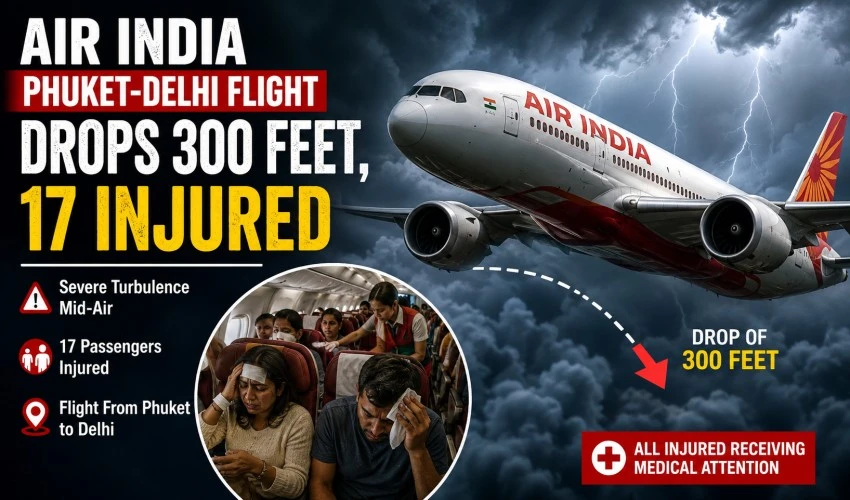
Aircraft Lands Safely in Delhi After Sudden Altitude Loss Near Odisha; DGCA Launches Investigation
An Air India flight traveling from Phuket, Thailand, to Delhi turned into a moment of panic on Tuesday, August 4, 2026, after the aircraft ran into severe turbulence mid-air and suddenly lost around 300 feet of altitude. The incident left 17 people — 13 passengers and four crew members — injured, though the plane landed safely at Delhi’s Indira Gandhi International Airport, and none of the injuries have been described as life-threatening.
The flight, operating as AI2379, was flying an Airbus A320neo registered as VT-EXO. It departed Phuket at approximately 8:25 am local time and touched down in Delhi shortly after 11 am, according to flight-tracking data. The aircraft was carrying 137 passengers along with eight crew members when the sudden jolt occurred during cruise, reportedly while flying over the Odisha region.
What Happened Onboard
According to officials with the Directorate General of Civil Aviation (DGCA), which is now investigating the episode, the pilot in command reported that the aircraft experienced a sudden and unexpected loss of roughly 300 feet in altitude. The abrupt drop threw unsecured passengers and crew members off balance, with several sustaining injuries as they were flung against seats, overhead bins, or the cabin ceiling.
Eyewitness accounts from passengers describe the flight as calm for much of its duration before the sudden jolt hit without warning. Several passengers recalled that the aircraft had been in the air for close to ninety minutes, and many travelers were still asleep when the turbulence struck early in the morning. The suddenness of the drop appears to have caught most people off guard, as many had not fastened their seatbelts, what had otherwise been a smooth cruise phase.
View this post on Instagram
Photos and videos that surfaced on social media in the aftermath showed a chaotic cabin scene — cracked ceiling panels, dislodged overhead compartments, and personal belongings scattered across the floor and aisles. Some images showed passengers with visible head injuries being helped off the aircraft, while others were seen being moved through the terminal in wheelchairs for further medical evaluation.
Aviation experts note that while the interior damage looked dramatic, panels and overhead bins are largely non-structural components. The visible destruction inside the cabin is typically a result of loose items and unbelted individuals being thrown around forcefully during a sudden loss of altitude, rather than any compromise to the aircraft’s structural integrity.
Injuries and Medical Response
Of the 17 people injured, one cabin crew member reportedly suffered what the DGCA official described as a “severe” injury, while another crew member sustained a lesser injury. The remaining injuries among passengers were characterized as minor.
Emergency medical teams were on standby when the aircraft landed at IGI Airport, and injured individuals were swiftly moved for evaluation. Some were treated at a medical facility inside the airport itself, while others requiring more thorough assessment were transported to hospitals across the Delhi-NCR region, including Fortis Flt. Lt. Rajan Dhall Hospital in Vasant Kunj, Medanta Hospital in Gurugram, and the Indian Spinal Injuries Centre.
At Fortis Hospital, officials confirmed that an alert was received early afternoon regarding incoming patients from the Air India flight. Seven individuals — three passengers and four crew members — were brought to the hospital’s emergency department by ambulance and assessed immediately. Dr. Ujjwal Vaid, who heads the Emergency Department at Fortis Vasant Kunj, stated that all seven patients arrived conscious, oriented, and with stable vital signs. He added that none of the passengers had suffered major injuries, though the four crew members required continued observation and treatment, while the three passengers were treated and subsequently discharged.
Air India, in its official statement, sought to downplay the severity of the event, describing it as a “brief in-flight turbulence-related event during cruise” that resulted in only a “momentary change in altitude.” The airline emphasized that the aircraft landed safely and that all passengers and crew disembarked without further incident. It further clarified that there had been no serious injuries reported as of its statement, and that only a small number of individuals required medical assessment as a precaution.
Also Read: Why Were 100 Flights Cancelled at Delhi Airport?
Regulatory Investigation Underway
The DGCA, India’s civil aviation regulator, has opened a formal investigation into the circumstances that led to the sudden altitude loss. Regulators are expected to examine flight data, weather conditions along the route, and the actions of the flight crew during the turbulence encounter to determine what triggered the drop and whether any operational or procedural lapses contributed to the severity of the incident.
Turbulence-related injuries have become an area of increasing scrutiny in the aviation industry worldwide, especially following several high-profile incidents in recent years where sudden clear-air turbulence caused significant injuries on commercial flights. Aviation authorities globally have been pushing airlines to reinforce seatbelt compliance messaging and improve turbulence forecasting and detection technology to reduce the risk of such incidents.
Context: A Difficult Stretch for Air India
This latest episode adds to a string of high-profile safety and operational concerns that have dogged Air India in recent times. The airline, which has been undergoing a major transformation since its privatization and acquisition by the Tata Group, has faced intensified scrutiny over its safety record, particularly after a series of incidents involving its fleet over the past couple of years.
While turbulence incidents are not uncommon in commercial aviation and are rarely the fault of the airline or flight crew, the scale of injuries in this case — 17 people affected on a single flight — has drawn considerable public and media attention, particularly given the visible damage inside the cabin.
Aviation analysts point out that severe turbulence encounters, especially those causing a rapid and significant loss of altitude, can occur even with modern weather radar and forecasting tools, since clear-air turbulence can sometimes develop with little warning, especially over regions with complex atmospheric conditions.
What Happens Next
Passengers and crew members who were treated for injuries are expected to continue recovery, with hospitals monitoring those who sustained more serious injuries, including the cabin crew members still undergoing treatment. Air India has stated that it will continue providing support to affected passengers and crew as needed.
Meanwhile, the DGCA’s investigation will likely take several weeks to conclude, during which flight data recorders, cockpit voice recordings, and crew statements will be reviewed to build a full picture of the sequence of events. Findings from the probe could potentially inform updated safety protocols or crew training procedures, particularly regarding turbulence response and passenger safety communication during cruise phases of flight.
For now, Air India has reiterated that passenger and crew safety remains its top priority, and the airline appears keen to reassure travelers that such incidents, while unsettling, do not reflect a broader pattern of operational risk. As the investigation unfolds, more details are expected to emerge about the exact cause of the sudden altitude drop and whether any preventive measures could have reduced the number of injuries onboard.
The incident serves as a reminder to air travelers of the importance of keeping seatbelts fastened throughout a flight, even during smooth cruising conditions, as sudden and unpredictable turbulence can strike with little to no warning.