
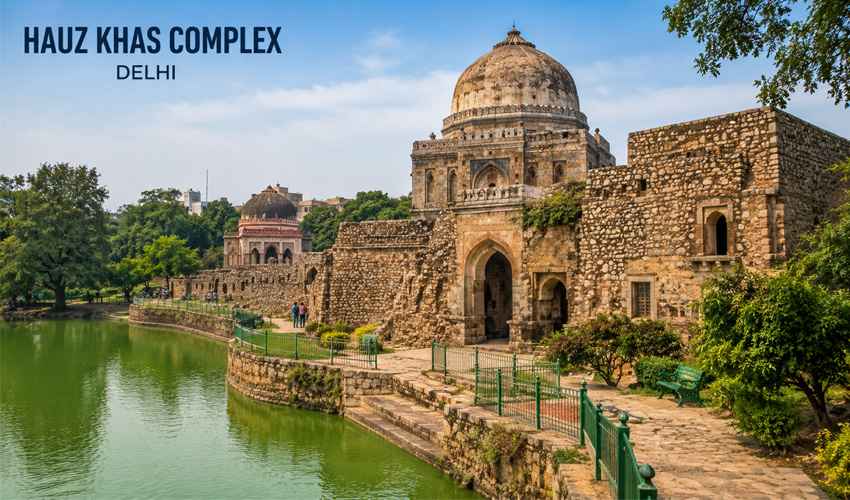
Delhi is a city that wears its history openly. Mughal tombs stand at roundabouts, Sultanate-era walls run alongside highways, and thousand-year-old step-wells hide behind apartment blocks. Yet even by Delhi’s remarkable standards, the Hauz Khas Complex occupies a singular position. It is a place where a royal medieval reservoir shimmers beside crumbling madrasa halls, where peacocks wander through deer-filled parkland, and where the stone tomb of a 14th-century Sultan gazes out over a skyline of modern towers. And just beyond its ancient walls, one of South Delhi’s most fashionable urban villages hums with cafes, galleries, and boutiques. Hauz Khas Complex is, quite simply, one of Delhi’s most layered and rewarding destinations — and it remains, inexplicably, one of its least crowded.
What Does Hauz Khas Mean?
The name itself is a key to understanding the place. Hauz Khas is a Persian phrase meaning “royal tank” or “royal reservoir” — derived from “hauz” (water tank or lake) and “khas” (royal or special). The name captures the original purpose of the site: a vast artificial water body commissioned to serve the needs of a growing medieval city. Over centuries, the name extended from the lake to encompass the surrounding monuments, the deer park, the urban village, and ultimately the entire neighbourhood — one of South Delhi’s most prestigious addresses today.
Origins: Alauddin Khilji and the Royal Tank
The story of Hauz Khas begins in the late 13th century, during the reign of Alauddin Khilji, the powerful and ambitious Sultan of Delhi who ruled from 1296 to 1316. The large water tank or reservoir was first built by Alauddin Khilji to supply water to the newly built fort and city of Siri — the second fortified city of Delhi built by the Khilji dynasty. It was originally known as Hauz-i-Alai, named after the Sultan himself.
The reservoir was a feat of medieval hydraulic engineering — a vast artificial lake excavated to collect rainwater and supply the densely populated Siri township. At its full extent, it spread across a remarkable area and served thousands of residents, soldiers, and scholars. It was, in the truest sense, the lifeblood of a medieval city.
However, like many ambitious infrastructure projects, the reservoir eventually fell into disrepair after Alauddin Khilji’s death. Silt accumulated, water levels dropped, and the great tank was gradually neglected through the turbulent political transitions of the early 14th century. It would take a new dynasty — and a new vision — to restore it to glory.
Firoz Shah Tughlaq: The Architect of the Complex
It was under Firoz Shah Tughlaq, who ruled the Delhi Sultanate from 1351 to 1388, that the Hauz Khas Complex was transformed from a neglected reservoir into one of the most important civic and scholarly sites in the medieval Islamic world. Firoz Shah not only undertook the task of desilting and restoring the lake but also added a series of magnificent architectural additions to its banks — a madrasa, domed pavilions, a mosque, and his own tomb.
The madrasa, established between 1352 and 1354, was the centrepiece of Firoz Shah’s vision. It was the largest madrasa in Delhi at the time and, following the Mongol siege of Baghdad in the mid-1200s which had devastated the Islamic scholarly world, it rose to become the most important centre of Islamic learning in the eastern world. Scholars, theologians, and students from across the subcontinent and beyond came to study here, drawn by royal patronage, a magnificent setting, and the intellectual atmosphere that Firoz Shah deliberately cultivated.
The madrasa building is L-shaped, built on two levels, with its long arcaded halls and open corridors overlooking the reservoir on one side and a walled garden on the other. The architectural style reflects the Tughlaq dynasty’s characteristic combination of Islamic and Hindu design sensibilities — trabeated construction, projecting cornices, column capitals, and decorative stone chajjas (overhanging eaves) supported on carved brackets sit alongside Persian-influenced domed chambers and crenellated rooflines.
The Tomb of Firoz Shah Tughlaq
Positioned at the central junction of the madrasa complex, the tomb of Firoz Shah Tughlaq is the most prominent monument within the site and the one that most visitors come to see. The tomb is an architectural marvel in the characteristic Tughlaq style — austere and powerful, built with local quartzite rubble and surface plaster, featuring a large central dome surrounded by smaller domes and arches. Inside, the tomb houses several graves, including those of Firoz Shah himself, his son, and his grandson, with a fourth grave of uncertain identity also present.
What makes the tomb particularly striking is its setting — it rises at the very edge of the reservoir, commanding views across the water on one side and the madrasa courtyards on the other. The interior ceiling carries verses from the Quran inscribed in decorative medallions, lending the space a meditative and reverent quality. It is a reminder that this was not merely a building but a deeply intentional statement about faith, learning, and the legitimacy of Tughlaq rule.
The Mosque and Pavilions
Adjacent to the madrasa and tomb, a small mosque served the scholars, students, and residents of the complex during its active years. While visitors cannot enter the mosque today, its exterior architecture — visible from the surrounding pathways — reflects the same spare elegance as the other Tughlaq-era structures in the complex.
Scattered across the garden area of the complex are six domed pavilions, varying in size and shape — rectangular, octagonal, and hexagonal — several of which contain graves. These structures are believed to date from the Tughlaq and Lodhi periods and represent different phases of the complex’s use as a burial ground and scholarly retreat over the centuries. Each pavilion rewards close inspection, with subtle architectural details and inscriptions that speak to the layered history of the site.
The Lake: Nature and Reflection
The Hauz Khas Lake itself remains one of the most serene and photogenic features of the complex. The water body, considerably reduced from its medieval extent but still substantial, mirrors the surrounding ruins, the tree canopy, and the changing Delhi sky with quiet beauty. In the early morning hours, the lake takes on a misty, almost otherworldly quality, with waterbirds moving across its surface and the stone tombs reflected in still water.
The lake is particularly spectacular at sunset, when the warm light catches the domes and arches of the medieval buildings and the water turns shades of gold and amber. It is a scene that photographers and artists return to repeatedly — and one that underscores how powerfully Firoz Shah’s urban design sensibility still works after seven centuries.
Deer Park and Wildlife
Abutting the historical complex is the Hauz Khas Deer Park, a large and well-maintained green space managed by the Delhi Development Authority. The park is home to spotted deer, peacocks, rabbits, and ducks, and its network of tree-lined pathways provides a welcome escape from city noise. Birdwatching is rewarding here too — the combination of the lake, park, and mature tree cover attracts a variety of resident and migratory bird species throughout the year.
Scattered through the deer park are additional medieval tombs and structures from the Tughlaq and Lodhi periods, including the Bagh-i-Alam ka Gumbad — the largest of the park’s tombs — and the Tuhfewala Gumbad, a smaller tomb set on a high platform. These structures are less visited than the main complex but are architecturally significant and worth exploring for those interested in tracing the full arc of Delhi’s Sultanate heritage.
Hauz Khas Village: Where History Meets Contemporary Culture
No account of the Hauz Khas Complex would be complete without its extraordinary neighbour — Hauz Khas Village. Just steps from the archaeological ruins, the village has undergone a dramatic transformation over the past few decades, evolving into one of Delhi’s most fashionable urban destinations. The narrow lanes and old havelis that once housed a residential community now accommodate designer boutiques, contemporary art galleries, craft stores, and an ever-changing roster of cafes and restaurants serving everything from Italian coffee to traditional Rajasthani thali.
The result is a strikingly unique urban experience — the ability to move within minutes from 14th-century stone tombs and meditative lakeside silence to a lively terrace cafe with views of medieval domes. Few cities in the world offer this kind of temporal juxtaposition so effortlessly, and Hauz Khas Village has become a symbol of how Delhi can hold its ancient identity and its contemporary energy in the same hands.
Visiting Hauz Khas Complex: Practical Information
The Hauz Khas Complex is open daily, typically from 10 AM to 6 PM. Entry is either free or available for a nominal fee depending on the specific area being visited. The nearest metro station is Hauz Khas on the Yellow and Magenta Lines, from which an auto-rickshaw or a 10–15 minute walk brings visitors to the site.
The best time to visit is between October and March, when Delhi’s climate is pleasant and the light is particularly beautiful over the lake in the late afternoon. Mornings are ideal for wildlife spotting in the Deer Park, while evenings offer magical views of the ruins as the sun sets over the water.
Conclusion
Hauz Khas Complex is Delhi at its most layered and luminous — a site where every stone has a story, every vista offers a meditation on time, and the ancient and modern coexist not in conflict but in a kind of productive, beautiful tension. Whether you are a student of history drawn by the Tughlaq architecture, a photographer seeking the perfect light on still water, a naturalist exploring the deer park, or simply someone looking for a quieter, more contemplative corner of a busy city, Hauz Khas Complex delivers something rare and enduring. It is, without question, one of Delhi’s most hidden and most magnificent gems.