
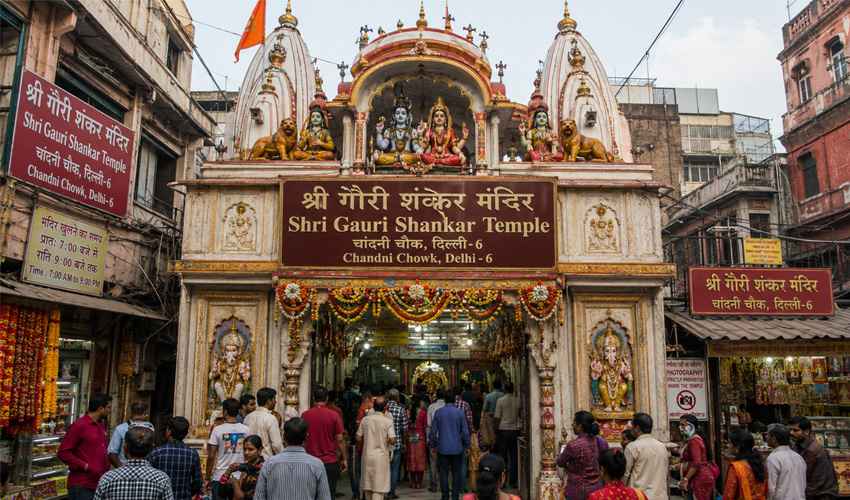
In the heart of one of the world’s oldest and most chaotic bazaars, where the air is thick with the fragrance of marigold garlands, the smoke of street food, and centuries of accumulated memory, stands a temple that has quietly witnessed the entire modern history of India. The Shri Gauri Shankar Temple in Chandni Chowk, Delhi, is not merely a place of worship — it is a living monument, a spiritual anchor embedded in the frantic pulse of a city that never truly sleeps.
The Soul of Chandni Chowk
Chandni Chowk itself is a street unlike any other. Conceived by the Mughal Emperor Shah Jahan’s daughter, Jahanara Begum, in the 17th century, and once described as the most magnificent bazaar in Asia, it has been a crossroads of traders, emperors, pilgrims, and poets. Amidst its maze of narrow lanes selling everything from silver jewellery to spices to wedding attire, the Shri Gauri Shankar Temple has stood as a constant spiritual presence — a place where the devout step away from the marketplace and step into something timeless.
The temple is dedicated to Lord Shiva and Goddess Parvati, the divine couple whose union embodies the cosmic balance of masculine and feminine energy. The name itself — Gauri Shankar — speaks of this sacred pairing: Gauri being a luminous name for Parvati, and Shankar a beloved name for Shiva. Together, they represent not just marital devotion, but the philosophical underpinning of existence itself: creation and dissolution, gentleness and austerity, the mountain goddess and the ascetic lord of Kailash.
Ancient Origins, Enduring Faith
The exact founding of the Shri Gauri Shankar Temple is rooted in antiquity, with historical accounts placing its origins roughly 800 years ago, making it one of the oldest temples in Delhi. Some traditions trace its foundation even further back, though the weight of documentation and local oral history supports a medieval provenance. What is certain is that the temple predates the construction of Chandni Chowk itself — meaning that when the Mughal avenue was being built around it, the temple was already old.
This remarkable longevity speaks to the reverence in which the site has been held across successive rulers, dynasties, and political upheavals. The Mughals, despite their Islamic faith, are said to have respected the sanctity of this shrine. Colonial-era records note its continued significance. And through Partition, Independence, and the churning transformations of post-modern Delhi, the temple has remained unshaken — not just architecturally, but spiritually.
The Sacred Heart of the Temple: The Gauri Shankar Shivling
The most venerated object within the temple complex is the ancient Gauri Shankar Shivling — a naturally formed stone that is said to be self-manifested, or swayambhu. Unlike installed idols, a swayambhu manifestation is considered to have appeared spontaneously by divine will, lending it extraordinary sanctity in Hindu theology. The Shivling here is believed to be approximately 800 years old, and devotees from across India make pilgrimages specifically to seek its blessings.
The Shivling is unique in its form — it features two naturally fused lobes, representing the inseparable union of Shiva and Parvati. This dual form makes it an exceptionally auspicious symbol for married couples and those seeking marital harmony. Newlyweds visit to seek blessings for their union; those hoping to marry pray here for a suitable partner. The temple has thus evolved into one of Delhi’s most beloved sites for prayers related to conjugal bliss and family prosperity.
Architecture and Atmosphere
The temple complex, though not monumental in size, possesses an intensity of devotional energy that larger temples sometimes lack. Its architecture reflects layers of renovation over the centuries while preserving its essential character. The sanctum sanctorum, where the ancient Shivling resides, is the spiritual nucleus around which the rest of the complex is organised.
A notable feature of the temple is the large brass Nandi — the sacred bull who serves as Shiva’s vehicle and eternal devotee — positioned facing the Shivling, as is traditional in Shaivite temples. The image of Nandi gazing steadfastly at the Lord, regardless of the noise and commotion of the surrounding bazaar, carries a quiet poetry of its own.
The walls of the temple are adorned with images of deities, and the atmosphere during worship hours is electric with the sound of bells, the chanting of Sanskrit mantras, and the steady flow of pilgrims. Priests conduct abhishek — the ritual bathing of the Shivling with milk, honey, rose water, and sacred water from the Ganga — throughout the day, each offering accompanied by the resonant recitation of the Shiva Panchakshara mantra: Om Namah Shivaya.
Festivals and Celebrations
The temple comes most dramatically alive during Maha Shivaratri, the great night of Shiva, when tens of thousands of devotees descend upon Chandni Chowk to offer their prayers through the night. The queue for darshan — the auspicious sight of the deity — stretches far into the surrounding lanes, yet the atmosphere is one of shared devotion rather than impatience. Bhajan singers, chanting groups, and the relentless ringing of temple bells create a soundscape that feels ancient and urgent simultaneously.
The month of Shravan (roughly July–August), considered the holiest month for Shiva worship, sees the temple thronged with devotees every Monday — Shiva’s sacred day. Many arrive carrying kanwars, decorated pots filled with holy water from the Ganga, which they offer to the Shivling as part of the traditional Kanwar Yatra pilgrimage.
Navratri, celebrating the nine divine forms of Goddess Durga, is another period of heightened activity, as the Gauri aspect of the temple — honouring Parvati — draws devoted women who fast, sing, and seek the goddess’s blessings for their families.
A Temple for All of Delhi
What makes the Shri Gauri Shankar Temple particularly remarkable is its democratic accessibility. Situated along one of Delhi’s busiest public thoroughfares, it has never been an exclusive or esoteric shrine. It belongs, in a profound sense, to everyone — to the shopkeeper who pauses his trade for a moment of prayer, to the morning commuter who folds hands instinctively as the rickshaw passes, to the newly arrived pilgrim from a distant village who has saved for years to make the journey.
In this sense, the temple mirrors the spirit of Shiva himself — a god who belongs equally to ascetics and householders, to the mighty and the marginalized, to those draped in silk and those covered in ash.
Visiting the Temple
The Shri Gauri Shankar Temple is located on the main Chandni Chowk road, easily reachable by the Chandni Chowk Metro Station on the Yellow Line. The surrounding area offers the full experience of Old Delhi: the famous paranthas of Paranthe Wali Gali, the silver market of Dariba Kalan, the spice market at Khari Baoli, and the towering Jama Masjid just moments away. A visit to the temple fits naturally into any exploration of this storied neighbourhood.
The temple is open for worship throughout the day, with the most spiritually charged hours being early morning at dawn and evening at dusk, when the aarti — the ceremonial waving of lamps — transforms the inner sanctum into something that feels genuinely otherworldly.
Conclusion: A Flame Without Interruption
In a city that has been built, destroyed, rebuilt, renamed, partitioned, and transformed more times than history can easily count, the Shri Gauri Shankar Temple represents something rare: an unbroken continuity of faith. For eight centuries and more, the lamp before the Shivling has not gone out. The bells have rung at dawn. The sacred water has flowed.
Chandni Chowk will continue to change — new metro lines, new facades, new generations of shopkeepers. But in the centre of it all, the ancient stone will remain, and the devotees will keep coming, drawn by something that no amount of modernity has ever quite managed to explain away.
 Suman Gupta