
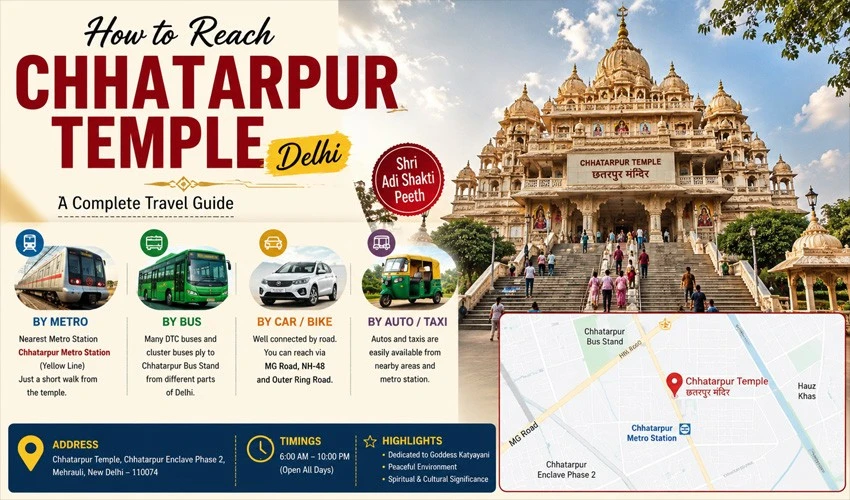
Chhatarpur Temple, officially known as Shri Adya Katyayani Shakti Peeth, is one of South Delhi’s most visited spiritual landmarks. Spread across acres of land and built almost entirely in white marble, this sprawling temple complex is dedicated to Goddess Katyayani, an incarnation of Goddess Durga. Every year, lakhs of devotees and curious travellers make their way here, especially during Navratri, when the temple turns into a sea of lights, flowers, and devotional energy.
If you’re planning a visit and wondering about the best way to get there, this guide covers everything — the metro route, distance from key parts of Delhi, parking availability, and a few practical tips to make your trip smooth.
Where Exactly Is Chhatarpur Temple Located?
Chhatarpur Temple sits on the Mehrauli-Gurgaon (MG) Road in South Delhi, close to the Qutub Minar complex. Its exact address is Main Chhatarpur Road, Dr. Ambedkar Colony, Chhatarpur, New Delhi – 110074. The temple’s location near major arterial roads and a dedicated metro station makes it one of the more accessible religious sites in the capital, whether you’re coming from within Delhi or from neighbouring NCR cities like Gurugram, Noida, or Faridabad.
How to Reach Chhatarpur Temple by Metro
For most visitors, the Delhi Metro is the easiest, cheapest, and most reliable way to reach the temple, especially given Delhi’s unpredictable road traffic.
Nearest Metro Station
The temple is served directly by Chhatarpur Metro Station, which lies on the Yellow Line (the same line that connects Samaypur Badli in the north to HUDA City Centre in Gurugram). This station is purpose-built to serve the temple and the surrounding residential colonies, so you won’t need to hop between multiple lines if you’re travelling on the Yellow Line.
Depending on which source you check, the walking distance between the station and the main temple gate ranges from roughly 500 metres to about 1 kilometre, translating to a 7–15 minute walk. If you’d rather skip the walk, autos and e-rickshaws are lined up right outside the station exit and will get you to the temple gate in under 5 minutes for a nominal fare (usually ₹20–30).
Step-by-Step Metro Directions
- Board a Yellow Line train headed towards HUDA City Centre (if you’re coming from the north) or Samaypur Badli (if coming from Gurugram side).
- If you’re travelling from another metro line — say the Blue Line or the Pink Line — interchange at a connecting station such as Rajiv Chowk, Kashmere Gate, Hauz Khas, or Central Secretariat, and get onto the Yellow Line.
- Alight at Chhatarpur Metro Station.
- Exit from the gate facing the temple side (Gate No. 2 is commonly used by visitors) and either walk or take a short auto ride to the temple.
Alternate Metro Station
If Chhatarpur station happens to be crowded or you’re coming from a direction where Qutub Minar Metro Station is more convenient, that’s a workable backup option too. However, it’s farther from the temple, requiring a longer walk of around 3 kilometres or a short auto/cab ride, so it’s best used only when Chhatarpur station isn’t practical for your route.
Metro Timings and Fare
Delhi Metro typically operates from around 5:00–5:30 AM until midnight, with trains running every 2–5 minutes during peak hours and slightly less frequently during off-peak hours. A one-way ticket to Chhatarpur station will usually cost somewhere between ₹10 and ₹60, depending on your starting station. You can pay using a token, the Delhi Metro Smart Card, or app-based QR tickets.
Distance from Popular Delhi Locations
Here’s a quick idea of how far Chhatarpur Temple is from some commonly referenced points in the city:
- New Delhi Railway Station (NDLS): Roughly 17–20 km, about 35–45 minutes by road depending on traffic.
- Indira Gandhi International Airport (IGI): Approximately 12 km, around 25–30 minutes by cab.
- Qutub Minar: Just about 4 km away, making it easy to combine both sightseeing stops in a single trip.
- Connaught Place: Around 18–20 km, roughly 40–50 minutes by road.
- Gurugram (MG Road area): About 12–15 km, roughly 25–35 minutes via NH48 or the MG Road stretch.
These numbers will naturally vary with your exact starting point and traffic conditions, so it’s a good idea to check a live navigation app before heading out, particularly during Delhi’s rush hours (8–10 AM and 6–8 PM).
How to Reach by Road (Car, Cab, or Bike)
If you’re driving down or booking a cab, Chhatarpur Temple is well-connected via the Mehrauli-Gurgaon Road, making it a straightforward drive from most parts of South and Central Delhi.
- By Self-Drive or Cab: Simply set your navigation to “Chhatarpur Temple” or “Chhatarpur Mandir” and follow MG Road. The temple is well-signposted, especially near the Qutub Minar stretch.
- By App-Based Cabs: Ola and Uber operate frequently in this area, so booking a cab is usually hassle-free, except during major festivals when traffic around the temple can get congested.
- By Bus: Several DTC buses ply routes connecting to Chhatarpur, with stops like Chhatarpur Mandir, Chhatarpur More, and Chhatarpur Crossing located within a few minutes’ walking distance of the temple.
Parking Facilities at Chhatarpur Temple
One of the more traveller-friendly aspects of visiting Chhatarpur Temple is the parking situation. Unlike several congested pockets of Delhi, the temple complex has dedicated space for visitor vehicles.
- The temple premises offer a large parking area for both two-wheelers and four-wheelers, making it convenient for families and larger groups travelling by car.
- Parking is generally free on regular days, though some reports mention a nominal fee at certain entry points, so it’s worth keeping some change handy just in case.
- During Navratri and other major festivals, footfall multiplies dramatically, and the temple management typically sets up additional temporary parking zones in the vicinity to handle the surge. Even so, expect longer queues and slower vehicle movement during these peak dates.
- If the main parking lot is full, there are usually informal parking spaces available along the approach road, though it’s advisable to arrive early on festival days to avoid the last-minute scramble.
Best Time to Visit (And Why It Affects Your Route Planning)
The temple is open through most of the year, but the ideal window to visit — factoring in both weather and crowd levels — is between October and March. If your goal is a peaceful darshan without heavy crowds, try visiting on a weekday morning. Weekends, festival days (especially Navratri), and evenings tend to draw significantly larger crowds, which can affect parking availability, auto fares near the metro station, and overall travel time.
Quick Travel Tips
- Carry small denomination cash for auto-rickshaws and any parking fee, as digital payments aren’t always accepted by local auto drivers near the station.
- If travelling during Navratri, consider taking the metro instead of driving, since road traffic and parking congestion peak significantly during this period.
- Combine your visit with Qutub Minar since it’s barely 4 km away — a convenient way to cover two major South Delhi attractions in one outing.
- Dress modestly (covering shoulders and knees) as is customary for temple visits in India, and be prepared to remove your footwear before entering.
Final Thoughts
Getting to Chhatarpur Temple is fairly straightforward whether you’re relying on the Delhi Metro, a cab, or your own vehicle. The dedicated Chhatarpur Metro Station on the Yellow Line makes public transport the most convenient and traffic-proof option for most visitors, while those driving down will appreciate the temple’s generous parking arrangements. Plan around festival crowds, keep the metro as your backup during heavy traffic days, and you should have a smooth journey to one of Delhi’s most peaceful spiritual retreats.
 Suman Gupta