
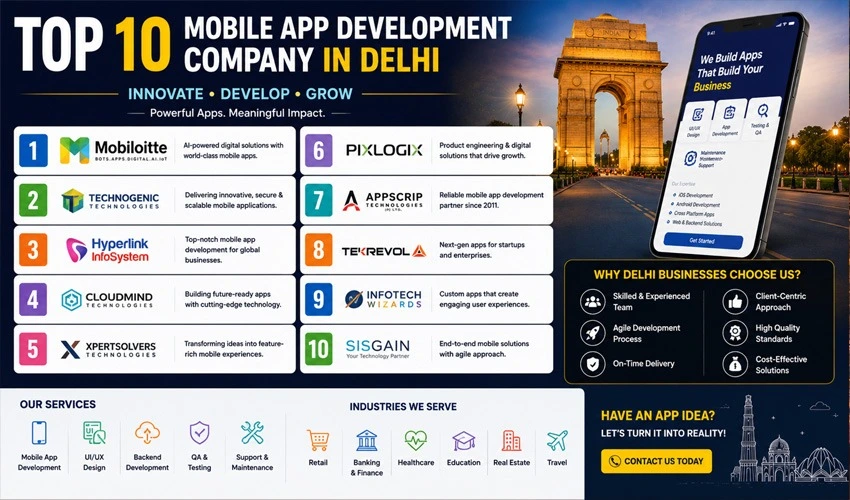
Delhi-NCR has firmly established itself as one of India’s most active hubs for mobile app development. With business districts like Nehru Place, Connaught Place, Noida, and Gurugram packed with IT companies, and a steady pipeline of startups, SMEs, and enterprise clients looking to digitize their operations, the region offers no shortage of app development talent. But that abundance also creates a real challenge: with hundreds of companies claiming to be “the best” or “top-rated,” how do you actually identify a partner capable of turning your idea into a stable, scalable, well-designed app?
This article looks at 10 established mobile app development companies with a strong presence in Delhi-NCR, along with the factors that typically separate a dependable development partner from one that simply looks good on a pitch deck.
1. TechAhead
TechAhead has built a solid reputation as a mobile app development company with deep expertise in cross-platform development for both iOS and Android. The company is frequently recognized for strong project management practices and consistent communication throughout the development lifecycle, which matters especially for clients managing complex, multi-phase app builds. TechAhead’s client base spans a range of industries, and the company is often noted for meeting or exceeding delivery timelines — a detail that matters enormously in app development, where scope creep and missed deadlines are common pain points.
2. AppSquadz
AppSquadz is a Delhi-NCR-based company offering a broad range of mobile app development services, including native Android and iOS development, hybrid apps, and web application development. The company positions itself around flexible engagement models, which can be useful for businesses that aren’t sure yet whether they need a full in-house-style dedicated team or a more limited scope-based engagement. AppSquadz also offers ongoing support and maintenance services post-launch, which is worth confirming with any vendor since app development doesn’t end at the app store submission.
3. Konstant Infosolutions
Konstant Infosolutions has built a track record working with a diverse client base, including recognizable names across retail, professional services, and consumer sectors. The company is generally known for its focus on on-time delivery and a stringent quality assurance process, making it a common choice for small and medium-sized businesses that need reliable execution without unnecessary back-and-forth. Konstant’s positioning tends to suit companies looking for a dependable, no-frills development partner rather than a boutique, highly customized creative studio.
4. Winklix
Winklix has operated out of Delhi-NCR since the mid-2010s and has grown into a company with a fairly large development team, working across iOS, Android, Flutter, and React Native. The company has built relationships with large enterprise clients across logistics, retail, healthcare, and fintech, and holds partner status with platforms like Salesforce and ServiceNow — a signal that it has experience integrating mobile apps with more complex backend enterprise systems rather than building purely standalone consumer apps. This makes Winklix a relevant option for businesses that need an app tightly integrated with existing enterprise software.
5. Mobiloitte
Mobiloitte occupies a slightly different niche compared to more generalist app development companies, with particular strength in blended projects that combine mobile development with blockchain and AI capabilities. For businesses building apps in the DeFi, Web3, or token-based application space, Mobiloitte’s specialization in these emerging technology areas can be a meaningful differentiator compared to companies that only offer conventional app development.
6. Krify
Krify has built a large portfolio of mobile applications across multiple industry domains, with development capabilities spanning iOS, Android, and Flutter. The company’s process typically begins with product discovery and research before moving into UX/UI design and development, which reflects a more structured, discovery-led approach compared to companies that jump straight into coding. Krify also emphasizes long-term partnership over one-off project delivery, offering ongoing co-management support after launch.
7. StudioKrew
StudioKrew has been active in the Delhi-NCR app development space since the early 2010s and has built several hundred mobile apps for clients across the US, UK, UAE, and India. The company’s process includes delivering a working prototype early in the engagement — typically within the first several weeks — which allows clients to validate direction before committing to full-scale production. This phased approach can reduce the risk of investing heavily in a direction that doesn’t resonate with end users.
8. DxMinds
DxMinds has established a strong presence in Delhi-NCR’s app development scene, with particular recognition in both iOS and Android development as well as mobile game development. The company has worked across a wide range of business sectors and has built a reputation over roughly a decade in the industry. For businesses considering gaming or highly interactive mobile experiences alongside standard business apps, DxMinds’ specific experience in game development is a relevant point of differentiation.
9. Cumulations
Cumulations focuses heavily on translating early-stage product ideas into functional MVPs, which makes it a strong option for startups still validating their concept rather than building a fully-featured app from day one. The company emphasizes agile development practices and close collaboration with clients throughout the build process, along with post-launch support to help sustain the product after its initial release.
10. Appslure
Appslure offers full-stack Android and iOS development along with broader enterprise mobility and offshore development services. The company has experience across sectors including vehicle tracking, IoT, location-based services, chat applications, and e-commerce, giving it a fairly broad base of technical experience to draw from. Appslure’s offshore development positioning also makes it a common choice for international clients looking for a Delhi-based extended development team rather than a purely local engagement.
What to Actually Look For in an App Development Partner
With so many companies claiming similar credentials, the real differentiation usually comes down to a handful of practical factors that are easy to overlook when comparing pitch decks and portfolios.
- Discovery process before development begins: A good development partner should insist on a discovery phase — understanding your users, business goals, and technical requirements — before jumping into design or code. Companies that skip straight to a fixed quote without asking meaningful questions about your product often end up building the wrong thing efficiently, which is arguably worse than building the right thing slowly.
- Technology stack transparency: Ask specifically which languages, frameworks, and tools will be used, and why. Native development (Swift for iOS, Kotlin for Android) tends to offer better performance and platform-specific features, while cross-platform frameworks like Flutter or React Native can reduce cost and speed up development for apps that don’t need deep native integration. The right choice depends on your specific use case, and a company that recommends the same stack for every project regardless of requirements is worth questioning.
- Post-launch support and maintenance: An app is never really “done” at launch — operating system updates, security patches, bug fixes, and feature iterations are ongoing needs. Clarify upfront what post-launch support looks like, what it costs, and how quickly the company responds to critical issues like crashes or security vulnerabilities.
- Portfolio relevance, not just portfolio size: A company that has built 500 apps isn’t necessarily the right fit if none of those apps resemble what you’re building. Ask for examples specifically in your industry or with similar technical requirements — real-time features, payment integrations, offline functionality, or complex third-party API integrations, for example — rather than being impressed purely by volume.
- Clear IP and ownership terms: Before signing any contract, make sure the agreement clearly states that you own the source code, design assets, and any custom-built components once the project is paid for. This sounds obvious, but disputes over code ownership are more common than many first-time app owners expect.
- Communication cadence and project management style: Ask how the company runs sprints, how often you’ll get updates, and who your actual point of contact will be throughout the project. Larger companies sometimes hand off day-to-day work to less experienced team members after the initial sales conversation, so it’s worth clarifying who you’ll actually be working with once the contract is signed.
Native vs. Cross-Platform: A Quick Consideration
One decision that comes up in nearly every app development conversation is whether to build natively for iOS and Android separately, or use a cross-platform framework that shares a single codebase across both. Native development typically offers the best performance and the deepest access to device-specific features, but it usually costs more and takes longer since two separate codebases need to be built and maintained. Cross-platform frameworks like Flutter and React Native have matured significantly and now offer near-native performance for most standard business apps, making them an increasingly popular choice for startups and SMEs looking to launch faster and control costs, while still leaving room to go native later if the app’s needs become more demanding.
A good development partner should be able to walk you through this trade-off specifically for your use case rather than defaulting to whichever technology they happen to specialize in.
How to Shortlist the Right Company for Your Project
Rather than picking a company purely based on rankings or review scores, it helps to start with a clear picture of your own requirements: your budget range, expected timeline, whether you need ongoing post-launch support, and whether your app requires specialized capabilities like AI, blockchain, or complex third-party integrations. From there, request detailed proposals from three or four shortlisted companies, ask pointed questions about their discovery process and technology recommendations, and, where possible, speak directly with a past client rather than relying solely on testimonials provided by the company itself.
Many businesses also find it useful to start with a smaller, well-defined project — an MVP or a single core feature — before committing to a larger, long-term engagement. This approach lets you evaluate a company’s actual communication style, code quality, and reliability with lower stakes before scaling up the relationship.
Final Thoughts
Delhi-NCR’s mobile app development ecosystem includes everything from large enterprise-focused firms with deep integration expertise to nimble teams built around MVP development for early-stage startups. The right choice depends far more on matching a company’s specific strengths to your project’s needs than on chasing the single “best” name on any list.
As with any vendor decision, it’s worth doing independent due diligence beyond this article — checking recent reviews on independent platforms, requesting references, and confirming that a company’s current team and portfolio still reflect the specific technical capabilities your project requires, since team composition and specializations can shift considerably over time.