
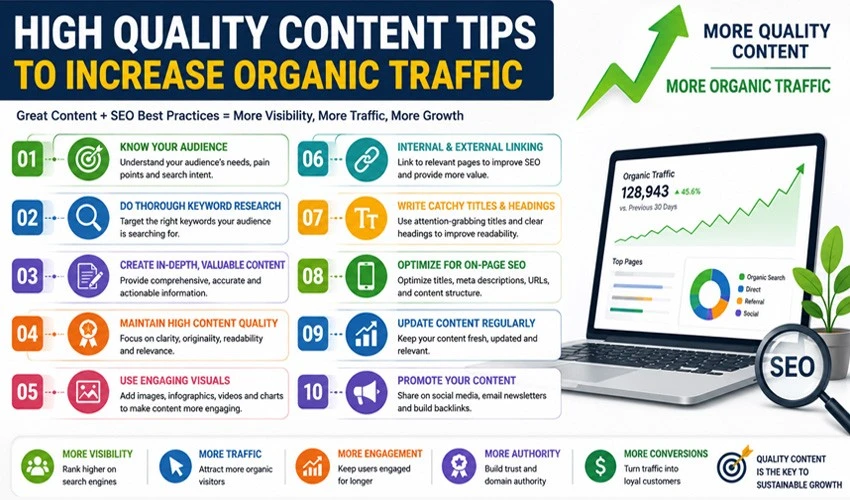
Every website owner wants more organic traffic, but very few actually get it in a sustainable way. The reason is simple: search engines have gotten remarkably good at telling the difference between content that was written to rank and content that was written to genuinely help someone. Chasing keywords without substance might have worked a decade ago, but today it is one of the fastest ways to plateau or even lose visibility. The sites that consistently grow their organic traffic are the ones that treat content quality as a long-term investment rather than a checkbox.
This article breaks down the practical, tested strategies that actually move the needle — not vague advice like “write good content,” but specific, actionable approaches you can start applying today.
1. Start With Real Search Intent, Not Just Keywords
Keyword research is still important, but it’s only the starting point. The real work is understanding what someone is actually trying to accomplish when they type a query into a search engine. Are they trying to learn something, compare options, make a purchase, or troubleshoot a problem? Content that matches search intent tends to rank better because it satisfies the searcher immediately, which reduces bounce rates and increases time on page — both signals search engines use to judge relevance.
Before writing anything, look at the top-ranking pages for your target keyword and ask what format they use. If most results are step-by-step guides, a listicle probably won’t outrank them. If most results are comparison tables, a long narrative essay may miss the mark. Matching format to intent is often just as important as matching topic to intent.
2. Answer the Question Better Than Anyone Else
Once you understand intent, the next goal is simple to state but hard to execute: be the best answer on the internet for that query. This doesn’t mean writing the longest article — length for its own sake is not a ranking factor and can actually hurt readability. It means covering the topic more completely, more clearly, and more usefully than competing pages.
A good exercise is to read the top five ranking articles for your target keyword and list every subtopic, question, and detail they include. Then ask what’s missing. Are there follow-up questions readers might have that none of these articles answer? Is there outdated information you can correct? Is there a fresher example, a clearer explanation, or a more current statistic you can add? Filling those gaps is often what separates a page that ranks on page one from one that never breaks past page three.
3. Structure Content for Both Readers and Search Engines
Even excellent research and writing can underperform if it’s poorly structured. Use clear, descriptive headings that make it easy for readers to scan and find the section relevant to them. Break up long paragraphs, use bullet points where appropriate, and keep sentences reasonably short. Readers today skim before they commit to reading, and a wall of unbroken text will lose people fast, no matter how good the underlying information is.
Structure also helps search engines understand your content. A logical heading hierarchy makes it easier for algorithms to identify what a page is about and to pull relevant snippets for featured results. Content that’s well-organized tends to earn more visibility not because of some hidden trick, but because it’s simply easier to parse.
4. Build Genuine Expertise and Trust Signals (E-E-A-T)
Search engines increasingly reward content that demonstrates experience, expertise, authoritativeness, and trustworthiness — often shortened to E-E-A-T. This matters even more for topics related to health, finance, legal matters, or anything that could affect someone’s wellbeing or decisions.
Practically, this means citing credible sources, being transparent about who wrote the content and what qualifies them to write it, and avoiding vague or unverifiable claims. Author bios, clear sourcing, and up-to-date information all contribute to trust. If your site covers a specialized topic, consider having subject-matter experts review or contribute to key pieces of content. This kind of credibility is hard to fake, and readers — as well as search engines — tend to notice when it’s missing.
5. Focus on Originality Over Rehashing
A significant amount of content published today is a repackaged version of the same five articles that already exist on a topic. This kind of content rarely performs well long-term because there’s no reason for a search engine — or a reader — to prefer it over the dozens of similar pieces already available.
Original data, first-hand experience, unique case studies, proprietary research, or a genuinely different angle on a familiar topic all help content stand out. Even something as simple as including your own testing results, a real example from your own work, or an opinion backed by evidence can differentiate a piece from generic competitors.
6. Keep Content Fresh With Regular Updates
Organic traffic is rarely a “publish and forget” outcome. Search engines favor content that stays accurate and current, especially for topics where information changes over time — statistics, tools, regulations, pricing, or best practices. A regular content audit, where you review your top-performing and declining pages every few months, can reveal outdated information, broken links, or stale examples that are quietly hurting performance.
Updating a piece doesn’t always mean a full rewrite. Sometimes it’s as simple as refreshing statistics, adding a new section that addresses a recently emerged sub-question, or replacing an outdated screenshot. These updates signal to search engines that the page is actively maintained, which can help it hold or regain rankings over time.
7. Use Internal Linking Strategically
Internal links are one of the most underused tools for improving organic traffic. They help distribute authority across your site, guide readers toward related content, and make it easier for search engines to understand the relationships between your pages. When you publish a new article, look for opportunities to link to it from relevant older pages, and vice versa — link new content back to foundational pieces that provide useful context.
A well-structured internal linking strategy, often built around pillar pages and supporting cluster content, helps establish topical authority. Rather than treating each article as an isolated piece, think of your content as an interconnected library where every page reinforces the credibility of related pages.
8. Optimize for Readability and User Experience
Great content can still underperform if the page itself is difficult to use. Slow load times, intrusive ads, poor mobile formatting, or confusing navigation all increase the likelihood that a visitor leaves before reading your content at all. Since user engagement metrics factor into how search engines evaluate page quality, technical and design issues can quietly undercut even the best-written article.
Prioritize fast-loading pages, mobile-friendly layouts, and a clean reading experience free of unnecessary distractions. Readability also matters at the sentence level — avoid unnecessary jargon, write in a natural tone, and vary sentence length to keep the content engaging rather than monotonous.
9. Write for Humans First, Algorithms Second
It’s tempting to over-optimize content around exact-match keywords, but forcing awkward phrasing to hit a keyword density target usually backfires. Modern search engines are sophisticated enough to understand semantic relationships between words and topics, so natural language that clearly covers a subject tends to perform just as well, if not better, than mechanically keyword-stuffed text.
The best long-term strategy is to write the way you would explain something to a knowledgeable colleague — clearly, accurately, and without unnecessary padding. Content that reads naturally tends to earn more shares, more backlinks, and more repeat visits, all of which reinforce organic growth over time.
10. Track Performance and Iterate
Finally, high-quality content isn’t a one-time achievement — it’s an ongoing process guided by data. Use analytics tools to monitor which pages are gaining or losing traffic, which queries they’re ranking for, and how engagement metrics like time on page and bounce rate are trending. This data tells you where to focus your updates, what topics deserve expansion, and which older content might need to be consolidated, rewritten, or retired.
Treating content as a living asset rather than a finished product is often the biggest mindset shift between sites that plateau and sites that keep growing their organic traffic year after year.
Final Thoughts
There’s no single trick that reliably increases organic traffic — it’s the combination of matching search intent, providing genuinely useful and original information, structuring content clearly, building trust, and maintaining it over time that compounds into sustainable growth. Search engines have gotten better at rewarding content that actually serves readers well, which means the most effective long-term SEO strategy is also the most straightforward one: create content so useful that people want to read it, share it, and come back for more.