
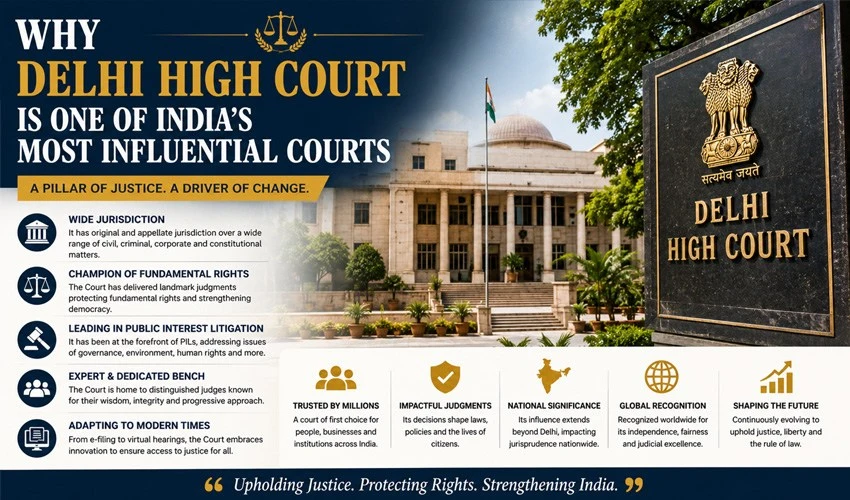
When people talk about the institutions that quietly shape the direction of Indian democracy, the courtroom rarely gets the same attention as Parliament or the Prime Minister’s Office. Yet tucked away on Sher Shah Road in the heart of the capital sits a court whose rulings have altered the course of civil liberties, corporate regulation, environmental policy, and personal freedom in India more than almost any other judicial body outside the Supreme Court itself. That court is the Delhi High Court.
Established on 31st October 1966 under the Delhi High Court Act, it is, by the standards of Indian judicial history, a relatively young institution. Before it came into existence, matters concerning Delhi were handled by the Punjab High Court through a circuit bench, an arrangement that grew increasingly impractical as Delhi’s population, administrative importance, and litigation load expanded rapidly after independence. Parliament recognised that a capital city sitting at the intersection of national governance, diplomacy, commerce, and constitutional interpretation needed a dedicated judicial forum of its own. Six decades later, that decision looks almost prophetic. The Delhi High Court has grown into something far bigger than a regional court — it has become a nerve centre of Indian jurisprudence.
A Court Positioned at the Centre of Power
Geography is not incidental to influence, and this is perhaps the single biggest reason the Delhi High Court punches so far above its weight. Because it sits in the national capital, it is the natural forum for disputes involving the Union government, central ministries, national regulators, and countless public sector institutions headquartered in Delhi. Challenges to central legislation, service matters involving All-India government employees, disputes involving the Election Commission, the Reserve Bank of India, SEBI, telecom regulators, and a host of other national bodies routinely land on its docket before they ever reach the Supreme Court.
This proximity to the machinery of the Union government means the Delhi High Court frequently becomes the first serious judicial voice on issues of genuinely national consequence — long before those issues are settled, if they ever are, by the apex court. In effect, the Delhi High Court often functions as a proving ground where the constitutional and administrative questions of the day are first tested, argued, and decided.
A Feeder Court for the Supreme Court
One measure of a High Court’s standing is how often its judges go on to serve at the Supreme Court of India. The Delhi High Court has one of the strongest track records in this regard, regularly producing judges who are elevated to the apex court. This is not accidental. The sheer diversity and complexity of matters that come before Delhi’s judges — constitutional writs, commercial disputes, intellectual property battles, service law, arbitration, and criminal appeals — gives them a breadth of exposure that few other High Courts can match. Over time, this has built a reputation for the Delhi High Court as a training ground for some of India’s sharpest judicial minds, further reinforcing its national relevance.
Landmark Judgments That Shaped Modern India
Few High Courts in the country can claim a body of case law as socially transformative as Delhi’s. Some of the most consequential judgments to emerge from an Indian courtroom in the last two decades trace back to this bench.
Its ruling reading down Section 377 of the Indian Penal Code to decriminalise consensual homosexual relations between adults was one of the earliest and boldest judicial interventions on personal liberty and dignity anywhere in the country. Though the verdict had a complicated legal journey afterward — being reversed and then ultimately vindicated years later at the Supreme Court — the original reasoning from the Delhi bench is widely credited with reframing how Indian courts and society talk about privacy, equality, and constitutional morality.
Beyond personal liberty, the court has repeatedly stepped in on questions of environmental regulation and public health in the capital, issuing directions on air pollution, vehicular emissions, industrial relocation, and waste management that have influenced policy well beyond Delhi’s borders. Its interventions during public health emergencies, including oxygen and medical-supply shortages during the COVID-19 pandemic, drew national attention for the court’s willingness to hold the executive accountable in real time.
The Delhi High Court has also been at the forefront of India’s evolving jurisprudence on free expression, media rights, and internet governance, frequently asked to weigh in on content takedowns, defamation disputes involving public figures, and the boundaries of permissible speech in a digital age. Its rulings on these questions are cited by lawyers and lower courts across the country, whether or not they carry the binding force of Supreme Court precedent.
The Commercial and Intellectual Property Powerhouse
If constitutional law is one pillar of the Delhi High Court’s influence, commercial and intellectual property litigation is the other. Because so many multinational corporations, pharmaceutical companies, technology firms, and media houses either operate out of Delhi or are compelled to litigate there due to jurisdictional links with central regulators, the court has developed deep specialised expertise in patent law, trademark disputes, copyright infringement, and arbitration.
The establishment of a dedicated Intellectual Property Division within the Delhi High Court — a first of its kind among Indian High Courts — further cemented this reputation. Patent disputes involving pharmaceutical giants, trademark battles between global brands, and copyright fights in the entertainment and publishing industries are routinely fought and decided here, making Delhi something close to India’s unofficial IP capital in a judicial sense.
This commercial sophistication matters for a country trying to attract global investment. Predictable, well-reasoned, and reasonably fast commercial adjudication builds confidence among businesses and investors, and Delhi’s High Court has increasingly become a benchmark for how Indian commercial law can be interpreted with clarity and rigour.
A Consistent Check on Executive Power
Because it is the primary judicial forum for challenges against central government action, the Delhi High Court is often the first stop for citizens, activists, journalists, and opposition figures seeking to contest decisions made by ministries, regulatory bodies, or law enforcement agencies operating in the capital. This has placed the court in a position where its rulings on preventive detention, bail, free speech, and administrative fairness carry outsized symbolic and practical weight.
Whether the issue is a habeas corpus petition, a challenge to an internet shutdown, or a plea against an arrest under a central statute, the Delhi High Court’s response often becomes the first indicator of how the judiciary as a whole is likely to view an issue. That early-mover role gives it a kind of agenda-setting power that other regional courts, dealing primarily with state-level matters, simply do not have.
Volume, Visibility, and Media Attention
Influence is also a function of visibility, and few High Courts attract as much sustained media coverage as Delhi’s. National newspapers, television channels, and now digital legal media are headquartered in or around the capital, meaning that hearings, orders, and even oral observations from Delhi High Court judges are reported almost in real time. This visibility means that judgments delivered here don’t just settle disputes between litigants — they shape public discourse, influence policy debates, and sometimes even pressure the government into responding faster than a legislative process alone would allow.
The court also handles an enormous caseload, spanning writ petitions, commercial suits, criminal appeals, and arbitration matters, giving it constant opportunities to refine legal doctrine across nearly every branch of law.
A Judiciary That Reflects the Capital’s Complexity
Ultimately, the Delhi High Court’s influence flows from the unique position Delhi itself occupies in Indian life: the seat of Parliament, the headquarters of central ministries, the base for major regulators and public institutions, and a magnet for national and international commerce. A court operating at that intersection cannot help but be pulled into the biggest legal questions the country faces.
Nearly sixty years after its founding, the Delhi High Court has evolved far beyond its original mandate as a regional appellate body for the capital territory. It now functions as one of the most closely watched, frequently cited, and consequential courts in the country — a institution whose judgments ripple outward from Delhi to influence law, policy, and public life across India.
For law students, practitioners, businesses, and ordinary citizens alike, understanding how the Delhi High Court operates is not just an academic exercise. It is, in many ways, understanding how a significant part of Indian democracy actually functions in practice.