
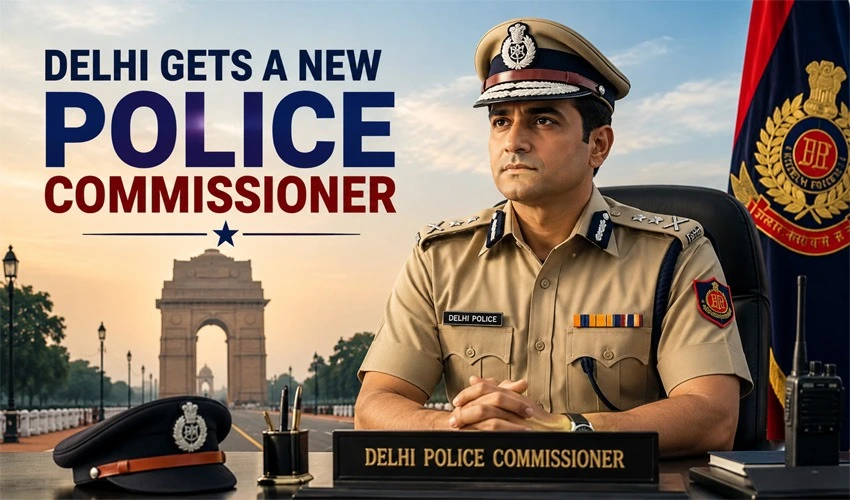
Delhi’s law enforcement leadership has changed hands once again, and this time the shift has come earlier than expected. On July 17, 2026, the Ministry of Home Affairs (MHA) appointed senior IPS officer Anurag Kumar as the new Commissioner of Police for Delhi, replacing Satish Golcha in a sweeping reshuffle that also touched dozens of other senior postings across the force. For residents of the capital, a change at the top of Delhi Police is never just an administrative footnote — it often signals shifts in policing priorities, security posture, and how the city’s roughly two crore residents experience law and order day to day. Here’s a clear breakdown of what happened, who Anurag Kumar is, and what it could mean going forward.
Who Is the New Commissioner?
Anurag Kumar is a 1994-batch IPS officer belonging to the AGMUT cadre (Arunachal Pradesh-Goa-Mizoram and Union Territories), the same cadre from which Delhi’s police chiefs are traditionally drawn. Before this appointment, he was serving as Special Director in the Intelligence Bureau (IB), India’s domestic intelligence agency, and was repatriated from that role to take charge of Delhi Police.
View this post on Instagram
His profile is notable for a few reasons. He holds a bachelor’s degree in engineering and has close to 32 years of experience spanning both field policing and national security work. Earlier in his career, he served as Deputy Commissioner of Police (DCP) across several Delhi Police districts, giving him direct, ground-level familiarity with the city’s policing challenges before he moved into intelligence work. Along the way, he has been recognized with the Police Medal for Meritorious Service in 2010 and the President’s Police Medal for Distinguished Service in 2016.
What sets Kumar apart from many of his predecessors is his background in intelligence rather than pure law-and-order administration. Having spent a significant stretch of his career at the IB handling sensitive national security matters, he arrives at Delhi Police headquarters with a skill set oriented toward intelligence gathering, threat assessment, and inter-agency coordination — capabilities that matter enormously in a city that hosts Parliament, foreign missions, and constant VIP movement.
Why the Change Happened Now
This is where the story gets a bit unusual. Satish Golcha, a 1992-batch IPS officer, had taken charge as Delhi’s 26th Police Commissioner in August 2025, and his tenure was originally expected to run until April 2027. Golcha was known for a no-nonsense reputation and had earlier played a key role as special commissioner during the response to the 2020 northeast Delhi riots.
Instead of completing that term, Golcha has now been directed to report to the Lieutenant Governor of Delhi for a new posting — effectively ending his tenure as commissioner roughly nine months after he began it, and well ahead of schedule. The MHA order, signed by an Under Secretary and circulated to the Chief Secretary of Delhi, the outgoing commissioner, and the Principal Secretary to the Lieutenant Governor, gave no detailed public explanation for the early exit. This wasn’t an isolated change either — the same reshuffle order reportedly moved around 70 officers in total, including roughly 50 IPS officers and 20 DANIPS officers, across ranks such as Special Commissioners, Joint Commissioners, Additional Commissioners, and DCPs. That scale suggests a broader restructuring of Delhi Police’s senior leadership rather than a single isolated swap at the top.
Kumar’s appointment takes effect from the date he formally assumes charge, and it remains open-ended — meaning he continues in the post “until further orders” rather than for a fixed term, which is fairly standard practice for this position.
What This Means for Delhi Residents
For the average resident, a change in Police Commissioner doesn’t usually alter day-to-day policing overnight — patrol routines, local thana operations, and beat constables continue functioning as before. But the top office does shape the broader direction of the force in a few practical ways worth watching.
Security posture around a high-profile city: Delhi is unlike most Indian cities in terms of the security demands placed on its police force: Parliament, the Prime Minister’s residence, foreign embassies, and a packed calendar of VIP visits and public events all fall under its watch. A commissioner with a deep intelligence background, like Kumar, may bring changes to how threat intelligence is shared and acted upon across police districts, potentially tightening coordination between Delhi Police and central agencies.
Cybercrime and online fraud: Like most Indian metros, Delhi has seen a steady rise in cyber fraud, digital arrest scams, and online financial crime complaints in recent years. How aggressively the new leadership prioritizes cyber cells and specialized units for these complaints will directly affect how quickly residents’ complaints are handled and how much public awareness campaigning the force undertakes.
Traffic and street-level policing: Commissioners often set the tone for enforcement priorities — whether that’s stricter traffic enforcement, renewed drives against illegal encroachments, or a push on community policing initiatives in residential colonies. Any shifts here typically become visible within the first few months of a new commissioner settling in, once senior district-level appointments are finalized.
Continuity amid the broader reshuffle: Because this leadership change came bundled with a much larger reshuffle of dozens of officers, residents may notice new DCPs or Additional Commissioners in their local districts as well, not just a new face at the top. It’s worth keeping an eye on official Delhi Police communications or local news for updates on your specific district if this affects your neighborhood watch groups, resident welfare association liaisons, or local police station contacts.
A Pattern of Frequent Turnover
It’s also worth noting that Delhi Police has seen unusually frequent changes at the top over the past couple of years. Golcha himself had succeeded S.B.K. Singh, who held the post for only about three weeks after the retirement of a previous commissioner. This kind of rapid turnover at the city’s top law enforcement post isn’t typical historically, and residents who follow local governance closely may reasonably wonder whether it reflects internal administrative recalibration, evolving security priorities, or simply personnel management decisions made by the Home Ministry. No official explanation covering the pattern as a whole has been made public.
What to Watch Next
In the coming weeks, residents can expect the usual formalities that follow a commissioner’s appointment: an official charge-taking ceremony, initial public statements outlining priorities, and likely meetings with senior officers to set the agenda for the months ahead. Given Kumar’s intelligence background, one area to watch is whether Delhi Police places renewed emphasis on preventive intelligence and coordination with central security agencies, alongside its regular law-and-order responsibilities.
For now, the practical takeaway for residents is straightforward: routine policing services continue as normal, but it’s worth staying attuned to official Delhi Police channels over the next few months for any announcements on new initiatives, district-level leadership changes, or shifts in enforcement priorities that could directly affect your neighbourhood.