
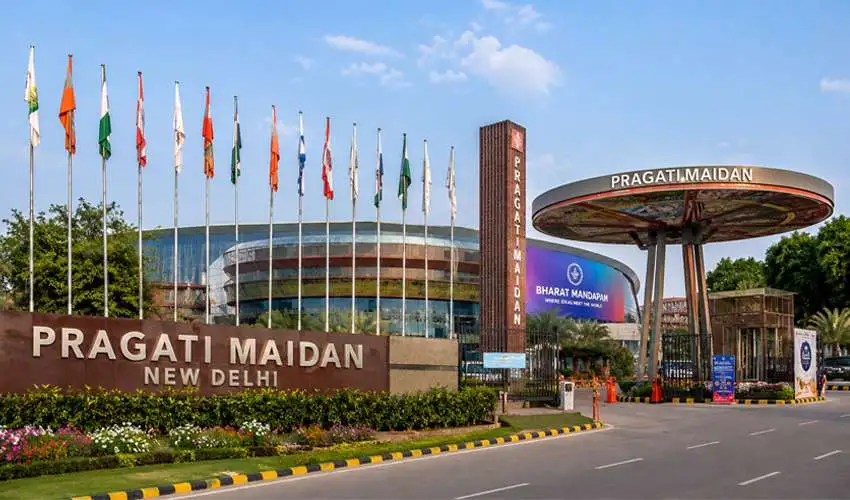
In the geography of New Delhi, few addresses carry the weight that Pragati Maidan does. Located along Mathura Road in the heart of Central Delhi, this sprawling 123-acre complex has served as India’s most important public stage for over five decades — a place where commerce meets culture, where nations conduct business, where books find readers, and where India periodically showcases its ambitions to the world. The very name, “Pragati Maidan,” translates simply and powerfully from Hindi as the “Field of Progress” — and across every chapter of its remarkable history, the name has proven worthy.
From its inauguration by Prime Minister Indira Gandhi in 1972, through decades of iconic trade fairs, World Book Fairs, and Auto Expos, to its dramatic transformation into Bharat Mandapam — India’s largest convention and exhibition complex — and its crowning moment as the host of the G20 Leaders’ Summit in September 2023, Pragati Maidan has never been merely a venue. It has been a mirror held up to India’s evolving identity and global standing.
The Birth of a National Institution: 1972 and the Asia 72 Fair
Pragati Maidan was inaugurated on 3 November 1972 by Prime Minister Indira Gandhi, on the eve of an international trade fair called Asia 72 — an event conceived to commemorate and celebrate 25 years of India’s independence. The complex was managed from the outset by the India Trade Promotion Organisation (ITPO), a trade promotion agency under the Ministry of Commerce and Industry, Government of India, and it was designed to give the newly independent nation a world-class platform to engage with global commerce.
In those early years, the complex offered around 61,290 square metres of covered exhibition space across 16 halls, alongside 10,000 square metres of open display area. It quickly became indispensable to Delhi’s institutional calendar, drawing businesses, state governments, international delegations, and millions of ordinary visitors to its gates each year. The complex was flanked by Mathura Road to its west, Bhairon Road to its south, and the main railway line to Central and Southern India to its east — a centrally located, well-connected site that maximised its accessibility.
Among the architectural landmarks of the original Pragati Maidan was the celebrated Hall of Nations, designed by architect Raj Rewal. The Hall was recognised internationally as the world’s first and then-largest space-frame structure built in reinforced concrete — a bold feat of engineering and design that brought Pragati Maidan global architectural recognition. Its eventual demolition during the redevelopment phase remains a subject of debate and mourning among Delhi’s design community, who viewed it as an irreplaceable piece of modernist heritage.
The India International Trade Fair: A November Tradition
If Pragati Maidan is the stage, then the India International Trade Fair (IITF) is its grandest annual performance. First held in 1980, the IITF is organised by ITPO every year from 14 to 27 November — a two-week extravaganza that has grown into one of the largest trade fairs in the world by both exhibitor participation and visitor footfall.
Each year, Pragati Maidan transforms into a bustling marketplace where nations, states, central ministries, public sector undertakings, and private companies converge to exhibit their best offerings. The IITF encompasses every imaginable sector — engineering goods, consumer products, automobiles, handicrafts, textiles, food and beverage, technology, and innovation. State pavilions showcase the unique produce, crafts, and industries of India’s diverse regions, while international pavilions bring the world to Delhi’s doorstep.
In the 2024 edition, over 3,500 exhibitors occupied approximately 107,000 square metres of space, with international participants from 11 countries including China, Egypt, Iran, South Korea, Sweden, Thailand, Türkiye, Tunisia, Lebanon, Kyrgyzstan, and the UAE. Indian representation included pavilions from 33 states and union territories, alongside 49 central ministries and public sector enterprises. For ordinary Delhiites, the IITF has long been a beloved annual tradition — a place to discover new products, taste regional foods, meet artisans from distant states, and experience the sheer productive energy of the country concentrated in one place.
The fair has consistently served as a launchpad for small and medium enterprises and a platform for rural artisans and craftspeople to connect with national and international buyers — fulfilling the original vision of Pragati Maidan as a space where economic progress is inclusive and wide-reaching.
Beyond the Trade Fair: A Year-Round Exhibition Powerhouse
While the IITF is its most famous event, Pragati Maidan hosts a remarkable calendar of exhibitions, expos, and conferences throughout the year. The New Delhi World Book Fair, organised by the National Book Trust, is among the world’s largest book fairs and one of the most beloved cultural events in Delhi’s annual calendar — drawing bibliophiles, publishers, authors, and students from across India and internationally. The Auto Expo, India’s premier automobile exhibition, has historically used Pragati Maidan’s halls to showcase global automotive innovations to hundreds of thousands of visitors.
AAHAR, the international food and hospitality industry exhibition, draws professionals from the hospitality sector annually. The complex has also hosted specialised expos covering sectors as diverse as machine tools, optical industries, security technology, leather and footwear, environmental technologies, and digital infrastructure. This breadth of programming makes Pragati Maidan a uniquely versatile institution — a venue that serves industry professionals, B2B networks, cultural communities, and the general public with equal facility throughout the calendar year.
The Great Transformation: From Pragati Maidan to Bharat Mandapam
By the 2010s, the original infrastructure of Pragati Maidan — built in the 1970s and 1980s — had aged visibly. Exhibition halls leaked during monsoons, lacked contemporary fire safety systems, and were unable to accommodate the technical demands of modern digital exhibitions and large international conferences. India’s growing ambitions as a global trade and economic power required a venue that matched its new stature.
The Cabinet Committee on Economic Affairs approved the redevelopment of Pragati Maidan in January 2017, sanctioning a budget of ₹2,254 crore for the transformation of the 123-acre site into a state-of-the-art Integrated Exhibition-cum-Convention Centre (IECC). A consortium of architecture firms — Arcop from Delhi and Aedas from Singapore — won the competition for the master plan and architectural design of the new complex, which was conceptualised to rival the greatest convention and exhibition venues in the world.
The redeveloped complex was inaugurated on 26 July 2023 by Prime Minister Narendra Modi, who named the convention centre Bharat Mandapam — a name reflecting India’s cultural grandeur and civilisational self-confidence. The total cost of the completed project stood at approximately ₹2,700 crore. With a total built-up area of 390,000 square metres, Bharat Mandapam includes a convention hall capable of seating 7,000 people in a single format — a capacity that surpasses the Sydney Opera House’s 5,500 seats and is five times the capacity of Vigyan Bhawan. The complex also features six modern exhibition halls spanning 150,000 square metres of exhibition area, an amphitheatre with a capacity of 3,000 people, over 5,500 parking spaces, and a stunning 7,000-square-metre waterbody with a laser musical fountain at its front plaza.
The IECC complex at Pragati Maidan now ranks among the top 10 exhibition and convention complexes globally, drawing comparisons with the Hannover Exhibition Centre in Germany and the National Exhibition and Convention Centre in Shanghai.
The G20 Summit: Pragati Maidan’s Defining Moment
Just weeks after its inauguration, Bharat Mandapam received its most consequential test. In September 2023, the complex hosted the G20 Leaders’ Summit — a gathering of the world’s most powerful heads of state and government under India’s G20 Presidency. The summit, held on 9 and 10 September 2023, placed Bharat Mandapam and Pragati Maidan at the very centre of global diplomacy and media attention.
The G20 summit was India’s largest diplomatic event in decades, and Bharat Mandapam handled it with a combination of logistical precision and cultural grandeur that drew widespread international praise. The venue’s design, incorporating elements inspired by India’s parliamentary architecture and Rashtrapati Bhawan, presented a setting of dignified national identity to the assembled world leaders. For Pragati Maidan — which had begun its journey as a venue to mark 25 years of independence — hosting the G20 summit in India’s 76th year felt like a moment of full-circle national arrival.
Getting There and Practical Information
Pragati Maidan is exceptionally well connected within Delhi’s transport network. The Pragati Maidan Metro Station on the Blue Line (Line 3) provides direct access to the complex, making it reachable from across the city and NCR with ease. The complex is also accessible by road from Mathura Road, Purana Quila Road, and Bhagwan Das Road, with a dedicated tunnel constructed as part of the IECC redevelopment project to decongest traffic around the area.
Multiple entry gates serve the complex at different points, and during major events like the IITF, visitor entry is regulated through designated gates with specific timings. The complex offers ample parking for both two-wheelers and four-wheelers, and food courts within the premises serve a range of Indian cuisines, particularly during large public fairs.
For business visitors, Bharat Mandapam’s convention facilities are available for booking through ITPO for conferences, summits, product launches, and cultural events, positioning it as Delhi’s — and India’s — first-choice MICE destination.
Pragati Maidan’s Enduring Significance
What makes Pragati Maidan extraordinary is not any single event or structure but the continuity of purpose it has maintained across more than five decades. In 1972, it was built to show the world a developing nation’s readiness for global commerce. In 1980, it gave that ambition an annual showcase through the IITF. Through the 1990s and 2000s, it served as the democratic marketplace where every Indian state and international partner could occupy equal floor space. And in 2023, refashioned as Bharat Mandapam, it hosted the leaders of the world’s twenty largest economies — signalling not just India’s readiness but its centrality in shaping the global order.
Pragati Maidan is, in the truest sense, what its name has always promised: a field of progress. Not just for the industries and institutions it has showcased, but for the nation it has grown alongside — restless, ambitious, diverse, and perpetually reaching forward.
Location: Mathura Road, New Delhi – 110001 | Nearest Metro: Pragati Maidan (Blue Line) | Managed by: India Trade Promotion Organisation (ITPO) | Flagship Event: India International Trade Fair (November 14–27, annually)