
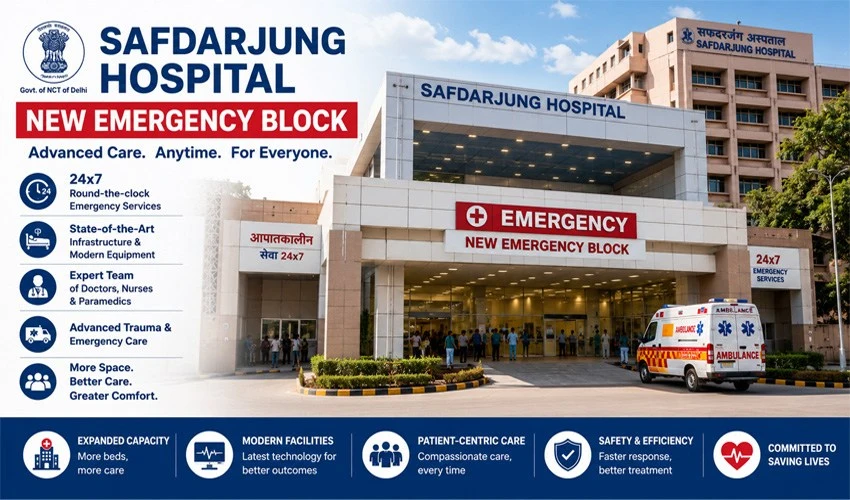
Delhi’s healthcare landscape changed significantly with the development of the New Emergency Block (NEB) at Safdarjung Hospital, one of the largest and busiest public hospitals in India. Designed to handle the overwhelming patient load that Safdarjung has faced for decades, the NEB stands today as a benchmark facility for trauma and critical care in the government hospital sector. For a population that depends heavily on free, high-quality emergency medical services, this development is more than an infrastructure upgrade — it is a lifeline for thousands of patients every month.
This article takes a detailed look at the New Emergency Block, its capacity, its specialized services, and why it matters for emergency and trauma care in the National Capital Region.
A Response to Rising Patient Load
Safdarjung Hospital has been functioning since 1954, and over the decades its bed capacity grew from a few hundred to roughly 1,600. Yet even with this expansion, the hospital struggled to meet demand. The Accident and Emergency department alone receives over a thousand patients daily, drawing cases not just from Delhi but from surrounding states as well. It is one of the busiest emergency departments in the country, and because Safdarjung follows a policy of not turning away patients — many of whom cannot afford private treatment — overcrowding became a chronic problem, with patients sometimes having to share beds while awaiting formal admission.
The New Emergency Block was conceived to directly address this challenge. Construction and planning stretched across several years, with the facility partially opening to the public in February 2018 and further beds and services becoming operational in phases afterward. The scale of the project made it clear from the outset that this was intended to be the largest emergency and trauma facility in India’s government hospital sector, surpassing even the neighboring All India Institute of Medical Sciences (AIIMS) in terms of dedicated emergency capacity.
Scale and Infrastructure
The numbers behind the New Emergency Block illustrate just how significant this facility is. It was designed as a 500-bed block, a scale unmatched by any other public hospital emergency facility in the country. Within this capacity, close to 100 beds were earmarked for intensive care, a dramatic increase from the roughly 80 ventilator-supported beds the hospital had before the block was built.
The block also houses 17 operation theatres, again the largest number attached to any single public hospital emergency facility in India. This allows for immediate surgical intervention in trauma cases — a critical factor in outcomes for patients with severe injuries, where delays in surgery can be the difference between life and death.
Beyond the emergency block itself, the broader redevelopment plan for Safdarjung Hospital included an accompanying superspeciality block with several hundred additional beds, intended to support specialties such as cardiac surgery, neurosurgery, and urology. Together, these two structures were meant to transform Safdarjung from an overstretched general hospital into a comprehensive tertiary care and trauma referral center.
Triage, Entry, and Patient Flow
One of the more thoughtful aspects of the New Emergency Block’s design is its patient flow system, built to reduce chaos and ensure that the sickest patients are seen first. Ambulances enter through dedicated gates on the Ring Road side, separate from the entry points used by walk-in patients, which are located on the hospital side of the building.
Every patient who arrives is first received by a medical social worker at the gate. Children aged twelve and below are directed straight to a dedicated paediatric and paediatric surgery emergency examination area, while all other patients proceed to a central triage desk in the main lobby. There, doctors under the supervision of a duty medical officer perform a preliminary examination, categorizing patients by the severity of their condition and the specialty best suited to treat them.
This triage-first model is central to how modern emergency departments manage high patient volumes. By rapidly sorting patients according to urgency rather than order of arrival, the system aims to ensure that a patient with a life-threatening injury is not left waiting behind someone with a minor ailment simply because they came in later.
Critical Care and Specialized Facilities
The New Emergency Block was built to function as a multidisciplinary facility, meaning that a wide range of specialists and services are available under one roof rather than requiring patients to be transferred elsewhere for basic diagnostics or specialist opinions. This is particularly valuable in trauma cases, where multiple organ systems may be affected simultaneously and speed of diagnosis directly affects survival chances.
Diagnostic services available within the block include in-house CT scanning, MRI, ultrasound, and digital X-ray, along with laboratories for pathology, biochemistry, and microbiology — all offered free of cost to emergency patients. This integration of advanced radiology and laboratory services directly within the emergency block eliminates the delays that come from sending patients to separate diagnostic departments, a factor that matters enormously in time-sensitive trauma and critical illness cases.
On the critical care side, the block includes high-end ventilators, portable ultrasound equipment, and dedicated intensive care unit beds, including specialized paediatric critical care. The intention behind this setup is to allow for genuine stabilization of critically ill or injured patients within the emergency block itself, before they are shifted for more specialized or long-term treatment elsewhere in the hospital.
The facility also brings together specialists from a wide array of disciplines — trauma and general surgeons, orthopaedic surgeons, neurosurgeons, and specialists in urology, ENT, and ophthalmology — so that complex, multi-system trauma cases can be managed by the right experts without unnecessary delay. A separate paediatric emergency care unit ensures that children, who often require very different clinical approaches from adults, are managed by teams equipped for their specific needs.
Coverage of Medical, Surgical, and Toxicological Emergencies
While trauma care is often the most visible face of the New Emergency Block, its scope extends well beyond road traffic accidents and physical injuries. The Department of Emergency Medicine at Safdarjung operates around the clock, managing medical, surgical, obstetric, paediatric, and toxicological emergencies as well. This includes everything from acute poisoning cases and severe infections to complications during childbirth and sudden surgical emergencies.
This broad mandate reflects the reality of public hospital emergency medicine in India, where a single facility often has to serve as the first point of contact for an enormous and diverse population, many of whom have no other means of accessing urgent medical care. The emergency medicine team, made up of faculty, resident doctors, nursing officers, and trained technical staff, is tasked with rapid triage, prompt resuscitation, and ensuring coordinated definitive care regardless of the nature of the emergency.
Modernization and IT Integration
Beyond physical infrastructure, the New Emergency Block was also designed with an eye toward modern hospital administration. This includes the incorporation of information technology systems aimed at moving toward paperless operations, alongside the deployment of more advanced diagnostic and interventional equipment. For a hospital handling over a thousand emergency cases a day, even incremental improvements in record-keeping and information flow can meaningfully reduce delays and administrative errors, which matter enormously in emergency settings.
Why This Matters for Delhi and Beyond
Safdarjung Hospital primarily serves patients who cannot afford private healthcare, making it an essential public resource for the National Capital Region and surrounding states. The New Emergency Block’s scale — its 500 beds, close to 100 ICU beds, 17 operation theatres, and integrated diagnostic services — represents a substantial expansion of what government-funded emergency and trauma care can look like in India.
The facility’s completion and phased inauguration, including formal dedication by senior government officials, was seen as a marker of investment in public trauma care infrastructure at a time when road traffic accidents, workplace injuries, and medical emergencies continue to place enormous strain on India’s healthcare system. By centralizing triage, diagnostics, surgery, and critical care within a single, purpose-built structure, Safdarjung’s New Emergency Block aims to reduce the fragmentation that so often costs precious time during medical emergencies.
Conclusion
The New Emergency Block at Safdarjung Hospital reflects a significant step forward in India’s public trauma and emergency care capacity. With its combination of scale, specialized critical care units, integrated diagnostics, and a structured triage system, it addresses long-standing challenges of overcrowding and delayed treatment that had defined emergency care at Safdarjung for years. For the many patients who rely on this hospital as their primary — and often only — option for urgent medical care, the New Emergency Block represents a meaningful improvement in access to timely, comprehensive, and free emergency treatment.