
Single malt whisky has quietly become one of India’s favourite indulgences. What was once a niche category reserved for connoisseurs and duty-free hauls is now a regular sight on wine shop shelves, hotel bars, and gifting counters across the country. But if you’ve ever tried comparing the price of the same bottle in two different cities, you already know the confusing part: the number on the label can swing by a thousand rupees or more depending on where you’re standing.
That’s not a pricing glitch — it’s how India’s alcohol taxation actually works. Since liquor is a state subject, every state sets its own excise duty, VAT, and retail margin structure. The result is a country where a bottle of Scotch can cost noticeably less in Gurugram than it does a few kilometres away in Delhi, or where Bangalore-made whisky is sometimes cheaper to buy in Karnataka than anywhere else in India. This guide breaks down what actually drives single malt pricing in India, how the major cities compare, and how to shop smarter regardless of where you live.
Why Single Malt Prices Change From City to City
Before looking at numbers, it helps to understand the mechanics behind them. Three factors do most of the heavy lifting:
1. State excise duty: Each state levies its own duty on imported and domestic spirits, and these rates are revised periodically. States with lower excise duty on premium spirits — historically Delhi, Haryana, and Chandigarh among them — tend to offer more competitive prices on imported single malts compared to states with steeper duty structures.
2. Import duty (for Scotch and other foreign whiskies): Imported single malts carry central customs duty on top of state-level taxes, which is why Scotch brands like Glenfiddich, The Glenlivet, and Macallan generally sit at a higher price floor than India-made single malts, even before local taxes are added.
3. Retailer margins and local demand: Government-run outlets, private retailers, premium liquor boutiques, and hotel/airport duty-free counters all price differently even within the same city, based on their margin structure and how much foot traffic they expect.
Because of this layered structure, it’s normal to see the same 750 ml bottle priced anywhere within a range of ₹1,000–₹2,000 depending on the state and the type of outlet you’re buying from — there’s rarely a single “correct” number, only a realistic range.
Delhi: Competitive Pricing for a High-Demand Market
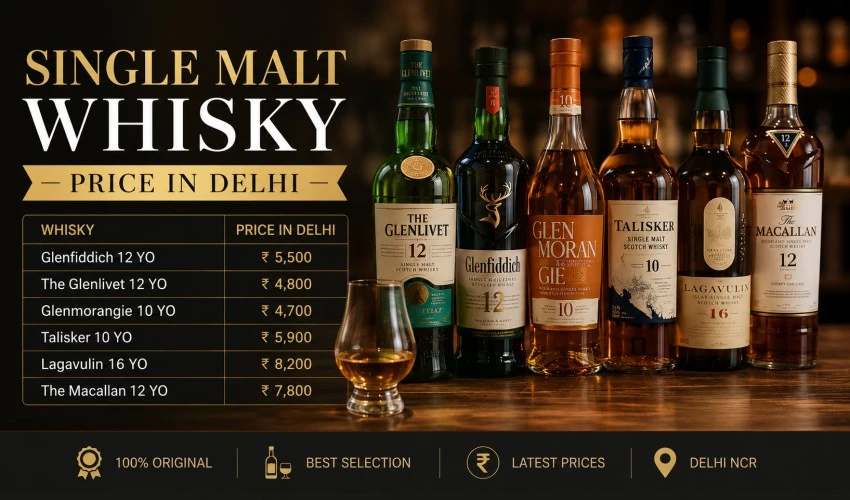
Delhi is consistently cited as one of the more affordable metro markets for premium Scotch whisky, largely due to a relatively moderate excise structure compared to some neighbouring states. A standard 750 ml bottle of an entry-level Scotch single malt like Glenfiddich 12 Year Old typically falls somewhere in the ₹3,600–₹6,200 range in the city, with the wide spread reflecting differences between government vends, premium retail counters, and periodic MRP revisions. The Glenlivet 12 Year Old tends to sit a little higher, often quoted around the ₹6,300 mark for a 750 ml bottle at licensed Delhi retail counters.
Delhi’s liquor retail is now dominated by government-run corporations rather than private shops, following changes to the city’s excise policy in recent years. This centralised system means pricing tends to be relatively standardised across most outlets in the city, though premium and boutique stores can still command a markup for wider selection, better storage, and billing convenience.
Mumbai: Higher Duties, Still Strong Availability
Mumbai and the broader Maharashtra market generally carry a heavier tax burden on alcohol than Delhi, which is reflected in noticeably higher shelf prices for the same international brands. Despite the cost difference, Mumbai remains one of the largest and most active premium whisky markets in the country, with strong availability across wine shops, five-star hotel bars, and specialty liquor stores. City-wise comparisons for premium Indian single malts like Rampur show Mumbai prices often running from roughly ₹6,700 to ₹9,200 for a standard 750 ml bottle — a noticeably wider and higher band than what similar bottles fetch in Delhi or Gurugram.
If you’re in Mumbai and price-sensitive, it’s worth checking whether a trip to Goa (a well-known low-tax market) or a duty-free purchase during travel makes more financial sense than a local retail buy, especially for premium and rare expressions.
Bangalore: Home Turf for Indian Single Malts, Yet Not the Cheapest
Here’s a twist that surprises a lot of buyers: Bangalore is where Amrut — India’s pioneering single malt brand — is actually distilled, yet Karnataka’s excise policy means the city isn’t necessarily the cheapest place to buy it. Broader market data on premium single malts in Bangalore shows a fairly crowded price band roughly between ₹7,200 and ₹8,000 for a range of both Indian and Scotch single malts in the 750 ml segment, with Rampur, Amrut, and Paul John often landing within a few hundred rupees of each other alongside international names like Bowmore and Glenmorangie.
The takeaway for Bangalore buyers: don’t assume home-state manufacturing automatically means the lowest price. Regional excise structure often matters more than where the bottle was actually made.
Kolkata, Hyderabad, Pune, and Chandigarh: The Middle Ground
Several other major cities occupy a middle position between Delhi’s relatively lower pricing and Mumbai or Bangalore’s higher bands:
- Kolkata is frequently described as offering fairly balanced pricing for imported Scotch, generally sitting between the more affordable northern markets and the pricier western and southern metros.
- Hyderabad tends to track close to the national average for most single malts, with premium Indian expressions like Rampur often priced between ₹7,000 and ₹9,500.
- Pune often runs slightly higher than Mumbai for some premium bottles due to local retail margins, even though it shares Maharashtra’s state excise structure.
- Chandigarh and Punjab, like Haryana, tend to benefit from comparatively lower excise duty, making them attractive markets for buyers in the wider NCR and northern belt.
Gurugram: The NCR Bargain Hunter’s Favourite
No conversation about single malt pricing in North India is complete without mentioning Gurugram. Haryana’s excise structure has long made it one of the more attractively priced markets in the region, which is why many Delhi-NCR residents specifically make the drive across the border for premium purchases. Rampur, for instance, is often priced around ₹6,000–₹6,500 in Gurugram — noticeably below what the same bottle might fetch in Bangalore or Mumbai, and even a shade below typical Delhi retail in some cases.
Indian Single Malts vs Scotch: A Quick Price Perspective
One of the more interesting shifts in the Indian whisky market has been the rise of homegrown single malts — Amrut, Paul John, Rampur, Indri, and Godawan among the best known. These brands mature faster than Scotch thanks to India’s hot, humid climate (which accelerates the ageing process considerably compared to Scotland’s cooler conditions), and many have gone on to win serious international recognition, including recent Best Indian Single Malt honours at global whisky awards.
Price-wise, entry and mid-tier expressions from Indian brands often land in a similar or even slightly lower band than comparable Scotch single malts once you account for import duty — think roughly ₹4,500–₹8,500 for standard 750 ml bottles across most of these brands, with premium or limited releases like Indri’s triple-cask expressions and Godawan’s higher-end bottlings pushing toward the ₹6,500–₹8,500 range and beyond.
Tips for Getting the Best Single Malt Price Wherever You Are
- Always check the printed MRP: Retail price caps are state-regulated, and the number printed on the bottle is your best reference point — don’t rely solely on what a shop verbally quotes.
- Compare government vends and premium retailers: In cities with a mixed retail structure, prices can differ meaningfully between a basic government-run outlet and a curated premium liquor store, even for the exact same bottle.
- Watch for state-border price gaps: If you live near a state boundary — Delhi-Gurugram, Mumbai-Goa-bound travel, or similar corridors — it’s worth checking whether a short trip saves a meaningful amount, especially on higher-value bottles.
- Factor in duty-free only if you’re actually travelling: Duty-free counters at airports can offer better pricing, but eligibility and quantity limits apply, and stock/pricing changes frequently, so don’t plan around it unless you have a confirmed international itinerary.
- Remember that prices move: Excise policies are revised periodically in every state, and MRPs get updated as a result. A price you saw quoted a few months ago may already be out of date.
Final Word
There’s no single “correct” price for a bottle of single malt in India — only a realistic range shaped by which state you’re in, which retailer you’re buying from, and how the brand is classified for tax purposes. Delhi and Haryana generally offer some of the more competitive pricing in the country, Mumbai and Bangalore tend to run higher despite strong local demand and, in Bangalore’s case, local production, and Indian single malts have carved out a genuinely competitive price-to-quality position against imported Scotch. Whichever city you’re shopping in, the smartest move is the same everywhere: check the current MRP, compare a couple of nearby outlets, and treat any online price list — including this one — as a starting reference rather than the final word, since excise policies and retail rates shift often enough to make yesterday’s number unreliable today.
This article is for general informational purposes only. Single malt whisky prices vary by state excise policy, retailer, and time of purchase, and figures mentioned here are indicative ranges rather than fixed prices. Please verify current MRPs with licensed retailers before purchase, and drink responsibly.