
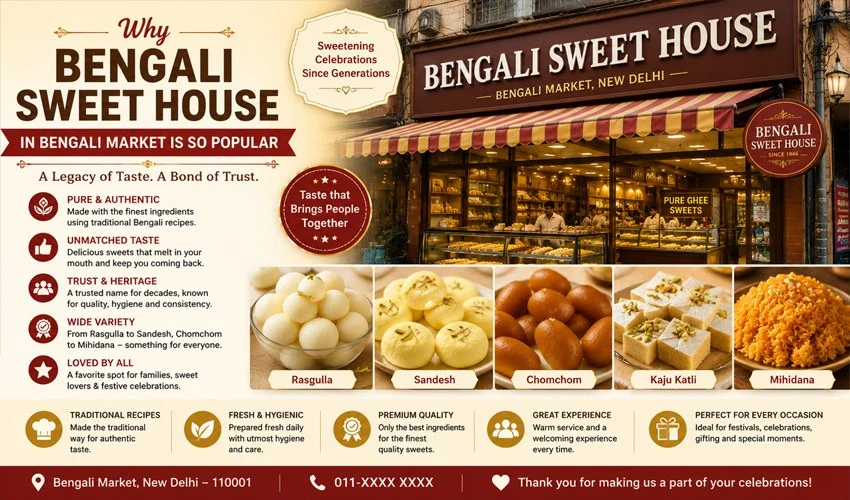
Walk into Bengali Market on any given evening and you’ll notice one thing immediately: there’s almost always a small crowd near the entrance of Bengali Sweet House, waiting for a table or a takeaway box of mithai. For a shop tucked into one corner of a fairly small market, that kind of consistent footfall says something. Bengali Sweet House isn’t just another sweet shop trading on a catchy name — it’s one of the two institutions that essentially built Bengali Market’s identity, and it has held onto that position for nearly nine decades. Understanding why it remains so popular means looking at its history, its food, and the very specific role it has played in Delhi’s food culture.
A Legacy That Goes Back Almost 90 Years
Bengali Sweet House’s story begins not in Bengal, but in Bikaner, Rajasthan. Two brothers, Lala Bhimsain Ji and Lala Banwari Lal Ji, moved to Delhi in 1936 and, driven by an entrepreneurial streak, began looking for ways to establish themselves in the city. Their first venture was a small shop near the Sessions Court on Ferozeshah Road. A year later, in 1937, they opened a second and more ambitious outlet in Bengali Market, right next to what was then the emerging grandeur of Lutyens’ Connaught Place.
That timing turned out to be significant. Connaught Place was being built as the commercial heart of the new capital, and Bengali Market sat just at its edge. The brothers weren’t simply setting up another mithai counter — they were pioneering something that didn’t really exist in Delhi at the time: a clean, family-friendly restaurant format for what had traditionally been street food. Chaat, snacks, and sweets had mostly been the domain of roadside carts. By bringing that food into an organized, sit-down setting, Bengali Sweet House essentially elevated the everyday snack into something people could enjoy with their families in comfort. That shift in format is part of why the shop is often described as having introduced “Bengali sweets” to Delhi’s culinary mainstream, setting a benchmark that other sweet shops in the city would later try to match.
Nearly a century on, that founding vision is still intact. The shop has grown and modernized, but it hasn’t strayed from the basic idea that made it work in the first place: familiar, comforting food, served well, in a setting that feels a step above the street.
The Food That Keeps People Coming Back
Popularity built on nostalgia alone doesn’t last a lifetime — it has to be backed by consistently good food, and this is where Bengali Sweet House earns its reputation.
Chaat that set the standard. The shop’s chaat counter is arguably as famous as its sweets counter. Dishes like raj kachori — a large, crisp shell stuffed with sprouts, potatoes, yogurt, and a mix of chutneys, then topped with crunchy sev — have become signature orders here. It’s a dish that rewards patience: multiple textures and flavors in a single bite, from tangy to spicy to sweet.
Homestyle classics done right. Not every dish here is elaborate. Rajma chawal, simple and unpretentious, remains one of the most ordered items, precisely because it tastes like something made carefully rather than mass-produced. It’s the kind of dish regulars order without even glancing at the menu.
Dahi bhalla for balance. Soft lentil dumplings soaked in chilled, thick yogurt and finished with tamarind chutney and roasted cumin offer a cooling contrast to the spicier items on the menu, and are especially popular during Delhi’s hotter months.
Sandesh and other Bengali sweets. Given the shop’s name and origins, it’s fitting that its Bengali-style sweets remain a highlight. Sandesh, made from fresh chhena, has a delicate texture and a clean sweetness that’s noticeably different from syrup-heavy classics like gulab jamun. It’s this range — from rich, indulgent sweets to lighter, more refined ones — that lets the shop appeal to a wide variety of tastes in a single visit.
Gulab jamun with rabri. For those who want indulgence rather than restraint, the shop’s gulab jamun served with thick, reduced rabri is about as rich as Indian desserts get, and it remains one of the most popular closing orders for a meal here.
Dry fruit mithai and modern additions. Beyond the classics, Bengali Sweet House has expanded its offerings over the years to include dry-fruit-based sweets, which do especially well during festive seasons when people buy sweets for gifting. The shop has also added sugar-free options to its lineup, a sign that it has kept pace with changing dietary preferences rather than resting entirely on tradition.
Consistency Across Generations
One detail that comes up again and again when people talk about Bengali Sweet House is how unchanged it feels compared to how it used to be. Families that visited as children are now bringing their own children, and the dishes they’re ordering are largely the same ones their parents ordered decades earlier. In a city where restaurants open and close constantly, and where food trends shift every few years, that kind of continuity is rare — and it’s a major part of the shop’s appeal. People don’t just come here to eat; they come here to recreate a memory.
This isn’t to say the shop hasn’t adapted. The addition of sugar-free sweets and a broader dry fruit selection shows a willingness to evolve with customer needs. But the core menu, the format of a sit-down restaurant serving street-food classics, and the emphasis on quality ingredients have remained largely intact since the brothers first opened the doors in 1937.
Location Matters Too
Part of Bengali Sweet House’s popularity is also simply about where it sits. Bengali Market itself occupies a small semicircular stretch of road near Mandi House, within easy reach of Connaught Place, and close to cultural institutions like the National School of Drama and Kamani Auditorium. It’s a natural stop for people heading to a play, an art exhibition, or simply out for an evening walk in central Delhi. Being positioned right alongside Nathu’s Sweets — the market’s other major institution — also means the two shops draw crowds to each other; visitors rarely come for just one and skip the other; they tend to sample both, comparing notes on which does a better raj kachori or a better peda.
The market’s manageable size works in the shop’s favor as well. Unlike sprawling food markets where visitors have to hunt through dozens of stalls, Bengali Market offers a tight, walkable cluster where Bengali Sweet House is impossible to miss. That visibility, combined with near-century-old word of mouth, keeps a steady stream of both loyal regulars and curious first-timers coming through the door.
A Reputation Built on More Than Just Sweets
Despite the name, calling Bengali Sweet House simply a “sweet shop” undersells what it actually offers. It functions more like a full-service Indian restaurant that happens to have an exceptional mithai counter attached. This dual identity — hearty savory food alongside classic sweets — means it can serve as a lunch stop, an evening snack destination, and a place to pick up gifts for a festival, all in a single visit. Few establishments manage to be genuinely excellent at all three roles simultaneously, and that versatility is a significant part of why it remains one of the most recommended food destinations in this part of Delhi.
The Bottom Line
Bengali Sweet House’s popularity isn’t the product of clever marketing or a recent viral moment — it’s the outcome of nearly ninety years of consistent execution. Two brothers from Bikaner built something that filled a genuine gap in Delhi’s food scene, and the shop that resulted has managed to hold onto its founding identity while still finding room to grow. Between its historic roots, a menu that balances comfort food with festive indulgence, and a prime spot in one of Delhi’s most beloved food markets, it’s easy to see why Bengali Sweet House continues to draw crowds, generation after generation.