
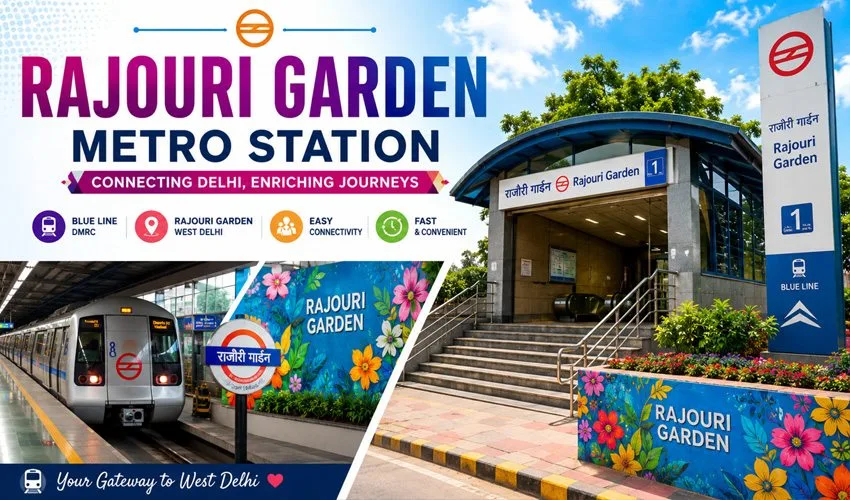
Nestled in the bustling commercial heart of West Delhi, Rajouri Garden Metro Station stands as one of the Delhi Metro network’s busiest and most strategically important interchange points. Serving as the meeting point between the Blue Line and the Pink Line, this elevated station has transformed the way lakhs of commuters travel across the National Capital Region every single day. Whether you’re a shopper heading to the area’s famous markets, an office-goer commuting to central Delhi, or a traveler connecting across the city’s sprawling metro grid, Rajouri Garden Metro Station plays a central role in making that journey smooth and efficient.
This article takes a closer look at the station’s history, its role on the Pink Line, connectivity options, amenities, and why it has become such an indispensable part of Delhi’s urban transport ecosystem.
Location and Significance
Rajouri Garden is a well-known residential and commercial neighborhood in West Delhi, home to popular markets, malls, and eateries that draw visitors from across the city. The metro station itself is located along Najafgarh Road, close to landmarks such as Shivaji Place and Vishal Enclave. Its central position within West Delhi makes it a natural hub for commuters heading toward Dwarka, Central Delhi, South Delhi, and even parts of East Delhi via the interchange network.
Given its location amid dense residential colonies and thriving markets, the station doesn’t just serve as a transit point—it has become an economic catalyst for the neighborhood, boosting footfall to nearby shopping destinations and driving demand for real estate and retail spaces in the vicinity.
A Brief History
Rajouri Garden Metro Station first opened on the Blue Line in December 2005, as part of the second phase of Delhi Metro’s expansion connecting Dwarka to Noida/Vaishali. For over a decade, it functioned purely as a Blue Line station, serving as a stop for commuters traveling between West and East Delhi.
The station’s role expanded significantly when the Pink Line arrived. As part of Delhi Metro’s Phase III expansion, the first section of the Pink Line became operational on 14 March 2018, running between Majlis Park and Durgabai Deshmukh South Campus, with Rajouri Garden included among the stations that opened in this phase. This addition turned Rajouri Garden into a full-fledged interchange station, dramatically increasing its importance and daily ridership.
Understanding the Pink Line
The Pink Line, sometimes referred to as the Ring Road Line because it largely follows Delhi’s Inner Ring Road, is one of the most unique and ambitious lines in the Delhi Metro network. It is India’s first operational ring metro, forming a large circular loop across the city, and at roughly 73 kilometers, it holds the distinction of being the longest metro line not just in Delhi but in the entire country.
The line connects with nearly every other operational line in the Delhi Metro system, creating a web of interchanges that allows commuters to move seamlessly between different parts of the city without having to travel all the way to the city center. Some of its major interchange points include the Red Line at Netaji Subhash Place and Welcome, the Yellow Line at Azadpur and INA, the Green Line at Punjabi Bagh West, the Violet Line at Lajpat Nagar, and of course, the Blue Line at Rajouri Garden.
Trains on the Pink Line run in a circular pattern, with the clockwise service referred to as the “+” Circular Line and the anti-clockwise direction known as the “-” Circular Line. This structure means commuters at Rajouri Garden can choose their direction of travel depending on their destination, whether that’s toward Majlis Park in one direction or toward Shiv Vihar and Maujpur-Babarpur in the other.
Rajouri Garden as an Interchange Hub
What sets Rajouri Garden apart from many other metro stations is the sheer convenience of its interchange design. Commuters can switch between the Blue Line and Pink Line without exiting the paid area, making transfers quick and hassle-free. The station is elevated and features four platforms in total—two serving Blue Line trains (toward Dwarka Sector 21 and toward Noida Electronic City/Vaishali) and two serving Pink Line trains (toward Majlis Park and toward Maujpur-Babarpur/Shiv Vihar).
This layout has made Rajouri Garden one of the more heavily used interchange stations in the network. Before the Pink Line’s integration, the station already recorded a healthy volume of daily commuters as a Blue Line stop. Once the Pink Line opened and expanded connectivity to West and South Delhi, footfall rose sharply, cementing the station’s place among the busier interchange nodes on the network, even if it doesn’t quite match the volumes seen at mega-hubs like Rajiv Chowk or Kashmere Gate.
The economic ripple effect of this increased connectivity has been significant. Local markets, including Rajouri Garden’s well-known marble market and its various retail clusters, have benefited from higher footfall. Shopping destinations like City Square Mall have become even easier to reach, drawing shoppers, tourists, and office workers who rely on the metro for last-mile convenience, often supplemented by autos and e-rickshaws.
Connectivity to Key Destinations
One of the biggest advantages of the Rajouri Garden interchange is the range of destinations it opens up for commuters. Someone heading toward Connaught Place, for instance, can simply board a Blue Line train and reach the area in about 20 minutes. Similarly, commuters traveling toward East Delhi neighborhoods like Shahdara have multiple route options: they can take the Pink Line toward Maujpur-Babarpur and then switch to the Red Line at Welcome, or take the Blue Line to Rajiv Chowk and interchange further through the Yellow and Red Lines.
Areas like Lajpat Nagar and Azadpur, both major Pink Line interchange points, are directly accessible without needing to change trains multiple times, which has considerably simplified travel for residents of West Delhi who previously needed longer, more convoluted routes to reach South or North Delhi.
Station Amenities and Accessibility
Rajouri Garden Metro Station is equipped with a range of passenger amenities designed to make the commuting experience comfortable and inclusive. The station offers DMRC-authorized parking facilities, allowing commuters who drive to easily park and continue their journey by metro. Feeder bus services are also available, extending the station’s reach into surrounding residential pockets that aren’t within immediate walking distance.
Accessibility has been a key focus at the station, with elevators and ramps installed to assist passengers with disabilities, elderly commuters, and those traveling with heavy luggage or strollers. Clear signage in both Hindi and English, along with regular announcements, helps first-time visitors and daily commuters alike navigate the station without confusion.
The station also has multiple entry and exit gates strategically placed to serve different parts of the surrounding neighborhood, reducing congestion at any single point and making it easier for commuters to reach their specific destination after exiting.
Operating Hours and Fares
Like most Delhi Metro stations, Rajouri Garden operates from the early morning hours until close to midnight, with the exact first and last train timings varying slightly depending on the direction and line. Fares are calculated based on distance traveled, and commuters have the option to pay using either physical tokens or the more economical smart card, which typically offers a small discount over token fares.
Peak and off-peak hours are also clearly defined, with peak hours generally falling between early morning office rush and evening rush periods. During these windows, train frequency increases to accommodate the higher volume of commuters passing through this crucial interchange.
Safety and Recent Developments
As one of the network’s high-traffic interchange points, Rajouri Garden has occasionally faced operational challenges, including periodic technical disruptions common to busy transit hubs. The Delhi Metro Rail Corporation has continued to invest in safety infrastructure at the station, including fire safety compliance measures, to ensure passenger security.
Recent studies and reports focused on interchange station design have also highlighted opportunities for improvement at high-traffic stations like Rajouri Garden, such as wider walkways, better ventilation, and more dynamic crowd management systems during rush hours. These recommendations reflect the ongoing effort by DMRC to keep pace with rising ridership as the Pink Line’s full circular loop increases overall network usage.
With Delhi’s population and commuter base continuing to grow, and with the Pink Line playing an increasingly central role in the city’s public transport strategy, stations like Rajouri Garden are likely to see even higher passenger volumes in the years ahead, reinforcing the need for continuous upgrades and capacity planning.
Conclusion
Rajouri Garden Metro Station is far more than just another stop on the Delhi Metro map—it is a critical junction that ties together West Delhi with the rest of the city through its interchange between the Blue Line and the Pink Line. From its origins as a Blue Line station in 2005 to its transformation into a major interchange hub after the Pink Line’s arrival in 2018, the station has consistently adapted to meet the growing transit needs of the region.
For residents of West Delhi, it offers a gateway to opportunities across the city, whether for work, shopping, or leisure. For visitors, it serves as an accessible entry point into one of Delhi’s most vibrant commercial districts. As the city’s metro network continues to expand and evolve, Rajouri Garden’s role as a key interchange station is only set to grow further, cementing its place as one of the most important nodes in Delhi’s ever-expanding public transit story.