
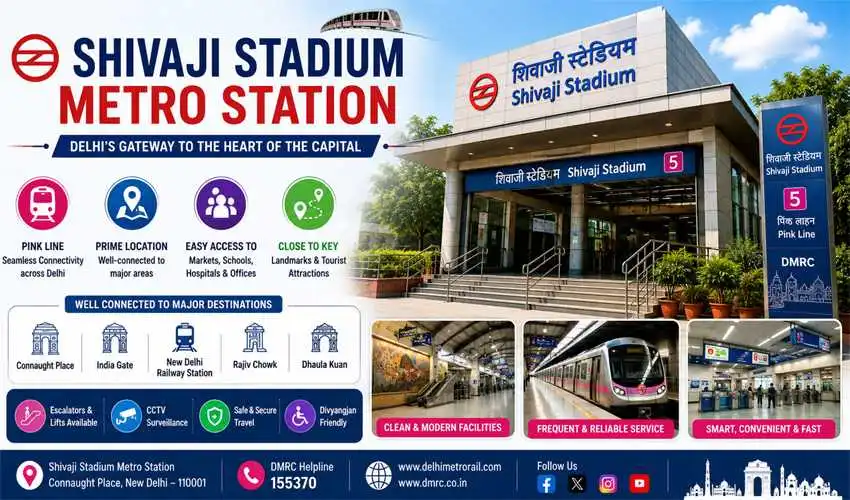
In the vast and ever-expanding web of Delhi’s Metro Rail network, few stations carry the kind of central significance that Shivaji Stadium Metro Station does. Nestled in the heart of New Delhi, steps away from one of the city’s most iconic commercial districts, this underground station is far more than a transit stop. It is a crossroads where history, commerce, culture, and modern infrastructure converge — a place that thousands of commuters, tourists, and business travellers pass through every single day.
Whether you are rushing to catch a flight from Indira Gandhi International Airport, heading to a meeting in Connaught Place, or simply exploring the capital, Shivaji Stadium Metro Station stands as one of the most convenient and well-connected entry points into the soul of Delhi. Understanding this station — its past, its present, and what surrounds it — offers a window into the transformation of urban mobility in India’s capital city.
A Station Born with the Airport Express Line
Shivaji Stadium Metro Station was inaugurated on 23 February 2011 as part of Delhi Metro’s Airport Express Line, also popularly known as the Orange Line. The Airport Express Line itself was a landmark achievement for Delhi’s public transport system — a high-speed corridor designed specifically to connect travellers swiftly between Indira Gandhi International Airport and the city centre.
The station sits strategically along Baba Kharak Singh Marg in the Connaught Place area, bearing the postal code 110001 — one of the most premium addresses in all of India. Its station code is SJSU, and it operates as a fully underground facility, with the platforms located three levels below street level.
In 2015, as part of Delhi Metro Rail Corporation’s (DMRC) initiative to generate revenue through strategic branding partnerships, the station was semi-renamed to ONGC Shivaji Stadium, with the oil and gas giant ONGC (Oil and Natural Gas Corporation) lending its name to the station. However, it continues to be widely known and referred to simply as Shivaji Stadium Metro Station by Delhi’s commuters.
Station Structure and Design
The station is built to handle substantial passenger volumes efficiently. As an underground station, it is structured across multiple levels — the street-level entry and exit points, a concourse level where fare control gates, ticketing counters, and commercial shops are located, and two platform levels below.
The platforms are configured as an island platform design, which allows passengers on both sides to board and alight with ease. Platform 1 serves trains heading towards Yashobhoomi Dwarka Sector 25, while Platform 2 serves trains travelling towards New Delhi station.
The interior of the station is spacious and well-lit, with clear bilingual signage in both Hindi and English, making it accessible and easy to navigate for both locals and tourists. Escalators and elevators are available to assist passengers with mobility challenges, making the station fully accessible to differently-abled individuals. The station is fully air-conditioned, providing much-needed relief from Delhi’s harsh summers, and automated fare collection gates ensure smooth and rapid entry and exit.
Cleanliness is maintained rigorously by DMRC staff, and the modern design sensibility of the station — like most stations on the Airport Express Line — reflects a higher standard of finish compared to many other lines, befitting its role as a premium rapid-transit corridor.
Connectivity and Transit Reach
What truly elevates Shivaji Stadium Metro Station beyond a local stop is its extraordinary connectivity. Sitting on the Airport Express Line, this station links travellers directly and rapidly to some of Delhi’s most critical nodes.
Towards the east, the line connects to New Delhi Railway Station, one of India’s busiest rail terminals, making it possible for inter-city train passengers to seamlessly transfer between the railway and metro systems. Towards the west, the line stretches through Dhaula Kuan, Terminal 1 IGI Airport, and IGI Airport (Terminal 2 and 3), eventually terminating at Yashobhoomi Dwarka Sector 25. This makes Shivaji Stadium an ideal starting point for anyone travelling to the airport, with the journey achievable in under 20 minutes from this station to the airport terminals.
One of the most notable and unique features of the Airport Express Line stations, including Shivaji Stadium, is the availability of an in-city airline check-in counter. Passengers travelling on select airlines can check in their baggage and obtain boarding passes right at the station, long before they reach the airport. This facility transforms the commuting experience entirely — removing the anxiety of navigating a busy terminal while managing heavy luggage.
The nearby Rajiv Chowk Metro Station, a major interchange hub, is also within close walking distance, providing access to the Blue Line (Line 3) and the Yellow Line (Line 2), dramatically expanding connectivity to virtually every part of Delhi and the National Capital Region.
Surrounding Landmarks and Neighbourhood
The station’s location in Connaught Place — arguably Delhi’s most famous commercial district — gives it an unmatched advantage as a destination station. Within a short walking radius of the station lies a dense cluster of iconic landmarks, offices, restaurants, and heritage sites.
Connaught Place (CP), with its distinctive colonial-era circular architecture, is home to flagship stores, global brands, restaurants, banks, and entertainment venues. The underground Palika Bazaar, Janpath market, and the broad Rajiv Chowk roundabout are all within easy reach. For office-goers, the stretch along Barakhamba Road and Baba Kharak Singh Marg puts many corporate offices and government buildings within a short walk.
The famous Gurudwara Bangla Sahib, one of Delhi’s most revered Sikh shrines, is only about 200 metres from the station entrance, making this a frequently visited stop for religious pilgrims and tourists alike. Hanuman Mandir, another well-known temple, is also just minutes away on foot.
Slightly farther but still comfortably accessible are some of Delhi’s crown jewels — India Gate, Rashtrapati Bhavan Museum, Jantar Mantar, and Talkatora Garden. For history enthusiasts, culture seekers, and casual tourists, Shivaji Stadium Metro Station serves as an ideal base from which to explore the historic and political heart of the Indian capital.
The Stadium that Lends Its Name
The station takes its name from the Shivaji Stadium, a historic sporting venue located in Connaught Place. Built in the post-independence era, the stadium has long been associated with field hockey and has hosted national-level tournaments and practice sessions for elite athletes. It was also part of the infrastructure spotlight during the 2010 Commonwealth Games. The stadium features FIH-grade synthetic turf and sits in a rare position — one of the very few hockey venues in central Delhi accessible directly by metro, making it valuable for athletes, coaches, and sports enthusiasts.
Passenger Amenities and Modern Features
Beyond transit, the station offers a range of passenger-oriented amenities. Dedicated parking facilities accommodate both two-wheelers and four-wheelers, a welcome convenience in an area as commercially dense as Connaught Place. Auto-rickshaws and cycle rickshaws are readily available outside the station exits, providing last-mile connectivity.
In early 2024, the station introduced an interactive museum exhibit that allows commuters to experience a simulated metro drive, bringing an element of engagement and education to the daily commute. This innovation reflects DMRC’s broader ambitions to make metro stations community spaces, not merely transit points.
Significance in Delhi’s Urban Fabric
Shivaji Stadium Metro Station represents the intersection of old Delhi and new Delhi — a modern underground facility serving a neighbourhood that has been the commercial soul of the capital for over a century. Its role in enabling airport connectivity, facilitating business travel, drawing tourists to heritage sites, and supporting the daily routines of thousands of Delhiites makes it one of the most functionally significant stations on any metro line in India.
As Delhi continues to grow and its metro network expands, Shivaji Stadium Metro Station remains a constant — a reliable, well-equipped, and strategically positioned hub that connects the city’s past to its fast-moving future.