
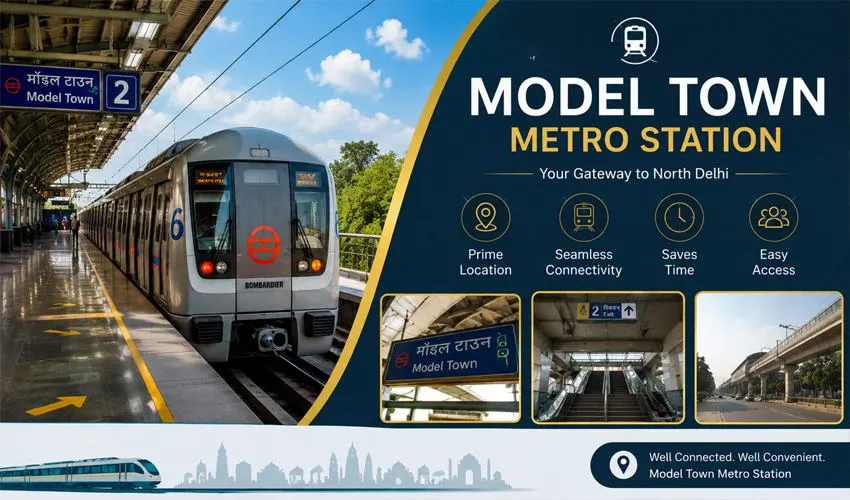
In the bustling urban landscape of North Delhi, Model Town Metro Station stands as one of the most strategically located transit points in the entire Delhi Metro Rail Corporation (DMRC) network. Serving thousands of daily commuters — from students and office workers to shoppers and tourists — this elevated station on the Yellow Line has become an indispensable part of life in North Delhi. Whether you are a first-time visitor to the capital or a seasoned Delhiite navigating the city, understanding this station’s layout, facilities, and connectivity can make your journey significantly smoother and more efficient.
A Brief History: How It All Began
Model Town Metro Station was inaugurated on 4 February 2009 as part of the Delhi Metro’s ambitious Phase II expansion. The Phase II project was designed with a clear purpose: to extend the metro network deeper into residential and commercial pockets of North Delhi that were previously underserved by rapid transit infrastructure.
Before the station opened, residents of Model Town and its adjoining colonies had no choice but to depend on Delhi Transport Corporation (DTC) buses, shared auto-rickshaws, and private vehicles. This resulted in perennial congestion along GT Karnal Road and Mall Road, especially during peak morning and evening hours. The arrival of the metro station transformed the commuting experience overnight, dramatically cutting travel times to central Delhi and beyond.
The neighbourhood of Model Town itself has a rich heritage. Built in the early 1950s by the DLF Group — then known as Delhi Land and Finance — it was one of the very first privately developed planned colonies in post-independence Delhi. The metro station today reflects the area’s evolution from a quiet residential enclave to a vibrant, well-connected urban hub.
Location and Station Details
Model Town Metro Station is situated along Mahatma Gandhi Road, Block B, Model Town Phase I, New Delhi – 110054. Its geographic coordinates place it at 28°42′10″N, 77°11′38″E, in the heart of North Delhi.
The station’s code under the DMRC system is MDTW, and it operates on the Yellow Line (Line 2) — one of the busiest and longest corridors in the entire Delhi Metro network. The Yellow Line stretches from Samaypur Badli in the north all the way to Millennium City Centre Gurugram (formerly HUDA City Centre) in the south, covering a total length of approximately 49.31 kilometres across 37 stations, including five interchange stations.
As an elevated station, Model Town sits above street level, offering commuters a vantage point over the surrounding neighbourhoods. The station has two side platforms — Platform 1 serving trains headed towards Millennium City Centre Gurugram (southbound), and Platform 2 serving trains headed towards Samaypur Badli (northbound). The station runs on a 25 kV 50 Hz AC overhead catenary electrification system, standard across the Delhi Metro network.
Adjacent Stations and Connectivity
Model Town is flanked by two important stations on the Yellow Line. To its south lies GTB Nagar Metro Station, roughly 1.25 kilometres away and just about two minutes by train, offering direct access to Delhi University’s renowned North Campus — a boon for the thousands of students who travel to and from the university daily. To its north lies Azadpur Metro Station, approximately 1.5 kilometres away. Azadpur is a critical interchange station where the Yellow Line meets the Pink Line (Line 7), enabling commuters to transfer and travel seamlessly towards East and South Delhi without needing to reach the central interchange points.
This positioning means that Model Town Station effectively acts as a connector between the Delhi University academic corridor to its south and the Azadpur commercial and interchange hub to its north — making it a pivotal stop for a wide cross-section of daily travellers.
Passenger Footfall
Even by conservative estimates, Model Town Metro Station records substantial daily ridership. According to DMRC data from January 2015, the station recorded approximately 2,34,056 passenger trips that month, translating to a daily average of around 7,550 passengers. Given the subsequent expansion of Delhi Metro services and the continued growth of the surrounding neighbourhoods over the past decade, current daily footfall figures are likely significantly higher. The station sees a noticeable spike during peak hours — between 8 AM to 12 noon and 5 PM to 9 PM — when office-goers and students flood the platforms in large numbers.
Facilities and Amenities
One of the hallmarks of a well-run metro station is the quality and range of its passenger facilities, and Model Town does not disappoint. The station is equipped with modern amenities designed to make every commuter’s experience comfortable and hassle-free.
Automated Fare Collection: The station uses automated fare collection gates, allowing passengers to enter and exit using DMRC smart cards or tokens purchased from the counter or vending machines. Smart card recharge machines are available at the station for added convenience.
Escalators and Elevators: Multiple escalators ensure smooth passenger flow between street level and the platform. Dedicated elevators are available for elderly passengers, those with disabilities, and travellers carrying heavy luggage, making the station highly accessible.
Security Infrastructure: Safety is a top priority at Model Town Station. The premises are monitored round-the-clock by a network of CCTV cameras, and CISF (Central Industrial Security Force) personnel are deployed throughout the station to ensure passenger safety.
Accessibility Features: True to DMRC’s commitment to inclusive design, the station is equipped with ramps for wheelchair users, Braille signage for visually impaired passengers, and designated priority seating areas on platforms and inside trains.
Restrooms and Food Stalls: Basic restroom facilities are available for commuters. Small food and snack stalls near the station exits provide quick refreshments for those on the go.
ATM: Banking facilities in the form of ATM kiosks are available in the station’s vicinity, adding to its convenience as a neighbourhood transit hub.
Nearby Landmarks and Points of Interest
The area surrounding Model Town Metro Station is rich with landmarks that make it a vibrant destination beyond just a transit point.
Chhatrasal Stadium is arguably the most iconic landmark near the station, located just 670 metres to the west. This legendary sports arena is a celebrated cradle of Indian wrestling, having produced Olympic medallists such as Sushil Kumar, Yogeshwar Dutt, Ravi Kumar Dahiya, Bajrang Punia, and Amit Kumar. For sports enthusiasts and wrestling fans, a visit to Chhatrasal Stadium is a must.
Azadpur Sabzi Mandi, accessible via the nearby Azadpur Metro Station, is one of Asia’s largest wholesale markets for fruits and vegetables and attracts traders, vendors, and buyers from across the National Capital Region.
Model Town Lake, a local green space beloved by residents for morning walks and leisure, is a short distance from the station. The area’s tree-lined streets, parks, and colonial-era architecture lend it a character quite distinct from other parts of Delhi.
Coronation Park and various local markets, educational institutions, and residential colonies form the broader fabric of the neighbourhood, all easily accessible from the station.
Bus Connectivity
One of the standout features of Model Town Metro Station’s transport ecosystem is its exceptional DTC bus connectivity. The station is served by an extensive array of Delhi Transport Corporation bus routes, including route numbers 78STL, 100, 100A, 101A, 101B, 112, 113, 120, 123, 124, 169, 171, 173, 191, 193, 195, 333, 341, 402, 883, 901, 921, 971, 982, and many more. Auto-rickshaws and cab aggregator services such as Ola, Uber, and Rapido are readily available at the station exits, further enhancing last-mile connectivity for commuters.
Why Model Town Metro Station Matters
Model Town Metro Station is far more than a transit stop — it is a nerve centre that keeps the daily rhythm of an entire North Delhi neighbourhood ticking. It connects students to universities, workers to offices, families to markets, and visitors to some of Delhi’s most culturally significant destinations. Its role in reducing road congestion, cutting carbon emissions, and providing an affordable, reliable mode of transport cannot be overstated.
As Delhi Metro continues to expand and modernise, Model Town Station remains a proud example of what urban infrastructure, when built thoughtfully and maintained well, can do for a city and its people. For anyone exploring North Delhi or simply commuting through it, this station is an essential landmark on the map of the capital’s ever-growing metro universe.