
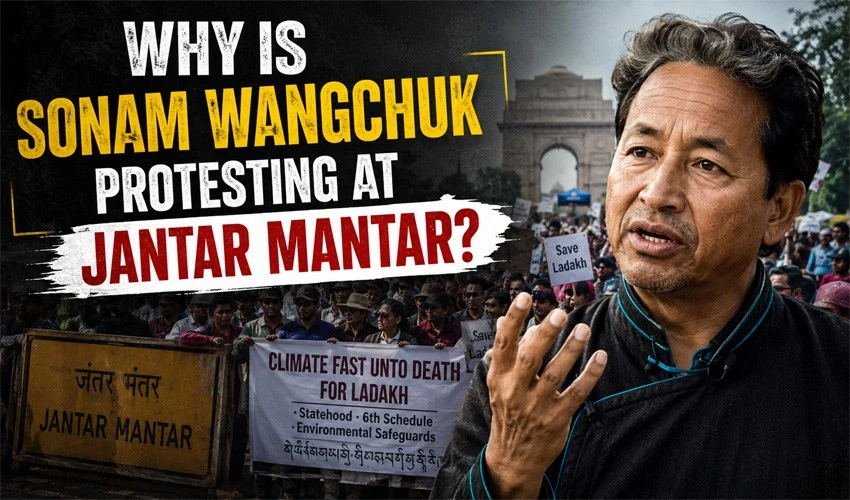
For more than three weeks now, one name has dominated headlines across India: Sonam Wangchuk. The Ladakhi engineer-turned-education-reformer, whose real-life work inspired a beloved character in the Bollywood film 3 Idiots, has been at the center of a dramatic hunger strike at Delhi’s Jantar Mantar. What began as a student-led agitation over exam paper leaks has, since his arrival, turned into one of the most closely watched protests India has seen in years — complete with police action, hospitalization, a court battle, and a march to Parliament. Here’s a complete breakdown of why Wangchuk is protesting, how the movement unfolded, and where things stand today.
How the Protest Began
The story doesn’t start with Wangchuk. It starts with a group of young Indians and a satirical political outfit called the Cockroach Janta Party (CJP), founded by Abhijeet Dipke. Since early June 2026, the CJP, along with student organizations, has been holding demonstrations at Jantar Mantar demanding the resignation of Union Education Minister Dharmendra Pradhan. Their anger stems from two major controversies: the 2026 NEET (National Eligibility cum Entrance Test) paper leak, which affected millions of aspiring medical students, and irregularities discovered in CBSE’s on-screen marking process. For students who had spent years preparing for these exams, the leaks and marking errors represented not just administrative failure but a betrayal of trust in one of the most high-stakes systems in Indian education.
The protests initially drew modest crowds. Delhi Police granted permission for the demonstrations as what they called a “one-time exception,” and the movement simmered for weeks without gaining major national traction.
Wangchuk’s Entry Changes Everything
That changed on June 28, 2026, when Sonam Wangchuk was invited to Jantar Mantar. The moment he arrived, he launched an indefinite hunger strike in solidarity with the students. Wangchuk was already a household name in India — not just for his cameo-worthy influence on Bollywood, but for years of genuine activism around education reform in Ladakh and, more recently, his campaigns demanding Sixth Schedule constitutional protections and statehood for the Union Territory of Ladakh.
View this post on Instagram
His involvement transformed the protest overnight. Crowds swelled to include senior citizens, ex-servicemen, school students, and families from across Delhi and neighboring states. Many of the young protesters admitted they hadn’t even heard of Wangchuk before his fast began, but were drawn in once they learned about his history of standing up for causes others had abandoned. What had been a niche student grievance turned into a broader referendum on accountability in India’s education system — and, for some, a symbol of resistance against the government more generally.
What Wangchuk Is Demanding
At its core, the protest has one central demand: the resignation of Education Minister Dharmendra Pradhan over the NEET paper leak scandal and the CBSE marking irregularities. Protesters argue that these failures affected the futures of millions of students and that accountability must sit at the top, not just with lower-level officials. Beyond the resignation demand, organizers have also called for structural reforms in how public examinations are conducted, tightened security around question papers, and greater transparency in the marking and evaluation process.
For Wangchuk personally, the fast also reflects his long-standing belief that India’s education system prioritizes rote memorization and high-stakes testing over genuine learning — a philosophy he has championed for decades through his work at the Students’ Educational and Cultural Movement of Ladakh (SECMOL) and the Himalayan Institute of Alternatives, Ladakh (HIAL).
The Escalation: Removal, Hospitalization, and a Court Battle
As Wangchuk’s fast stretched past two weeks, his health began to visibly deteriorate. By mid-July, opposition leaders were publicly urging him to end the strike, and another young protester at the site fainted and had to be hospitalized. Despite mounting concern, Wangchuk refused to back down, insisting he would continue until his demand was met.
Then, on Saturday, July 18, 2026, Delhi Police moved in. Plainclothes officers forcibly removed Wangchuk from the protest site and shifted him to Safdarjung Hospital, citing his deteriorating health as the justification. Protesters and supporters strongly disputed this framing, alleging the move was less about medical necessity and more about breaking the momentum of the agitation. Video footage of the removal spread rapidly online and became a flashpoint of its own, with many calling it a “tipping point” that drew even more people to Jantar Mantar in solidarity.
The controversy escalated further when Wangchuk’s wife, Gitanjali Angmo, moved the Delhi High Court, challenging the authorities’ reliance on an earlier medical order to justify keeping her husband hospitalized. Her petition sought his immediate discharge and questioned whether there was any genuine medical emergency at all. She also told reporters that Wangchuk’s health was “perfectly fine” and that she had tried, unsuccessfully, to have him shifted to a private hospital of the family’s choosing.
The Chalo Sansad March
Even from his hospital bed, Wangchuk didn’t stop pushing. He appealed to supporters to join a peaceful “Chalo Sansad” (March to Parliament) on Monday, July 20, 2026 — coinciding with the opening day of Parliament’s Monsoon Session. The timing was deliberate: by aligning the march with Parliament’s return, organizers hoped to force lawmakers to confront the issue directly as they arrived for the session.
View this post on Instagram
Ahead of the march, his wife relayed a conditional offer from Wangchuk: he would end his hunger strike if political leaders visited him in the hospital and assured him that the issue of education accountability would be raised on the floor of Parliament. Delhi Police, anticipating a large turnout, significantly increased security in central Delhi, deploying additional personnel and erecting barricades around Jantar Mantar and the routes leading toward Parliament.
On the day of the march itself, CJP founder Abhijeet Dipke led the procession, with Wangchuk expected to join in person if his health permitted after what had, by then, become a 23-day hunger strike. Opposition politicians, including MP Chandra Shekhar Aazad, and public figures such as actor Prakash Raj arrived at the protest stage to show solidarity, underscoring how far the movement had traveled from its origins as a student-led demonstration.
Why This Protest Matters
Beyond the specifics of exam leaks and a minister’s resignation, the Wangchuk-led protest has come to symbolize something larger: a rare, visible challenge to the government during a period of relative political calm. Observers have noted that it represents one of the more significant displays of public dissent in years, drawing together students, opposition politicians, celebrities, and ordinary citizens under a single cause. Whether or not Pradhan ultimately resigns, the protest has already forced a national conversation about exam integrity, government accountability, and the limits of dissent in the capital.
As of the latest updates, Wangchuk remains hospitalized, his fast unresolved, and the standoff between protesters and authorities very much alive. What happens in Parliament this week, and how the government responds to the Chalo Sansad march, will likely determine the next chapter of a protest that has already reshaped the national conversation around education reform in India.