
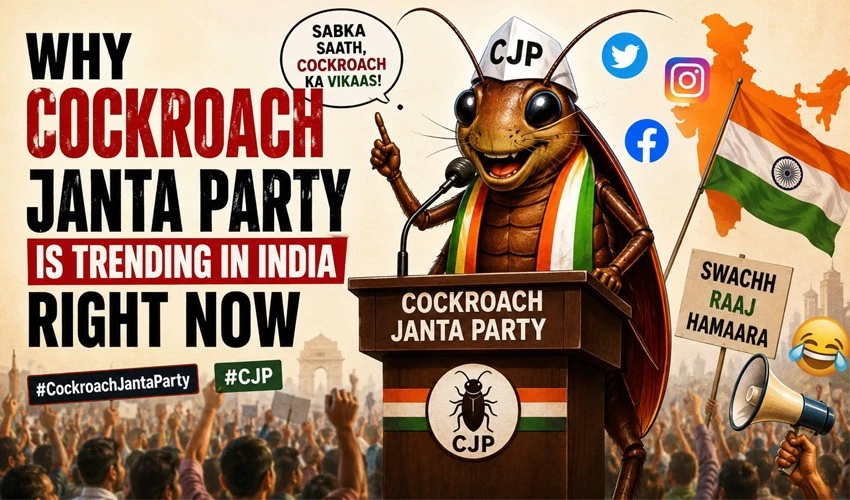
If you’ve spent any time on Indian social media over the past two months, you’ve almost certainly seen the name Cockroach Janta Party — often shortened to CJP — paired with images of young protesters in cockroach costumes, viral hashtags, and now, live news coverage of a hunger strike outside Parliament. What started as a sarcastic response to a single courtroom remark has snowballed into one of the most talked-about political movements in recent Indian history. Here’s the full story of how it began, why it’s exploded, and why it’s dominating headlines right now.
It All Started With a Courtroom Remark
The origins of CJP trace back to May 15, 2026, during a Supreme Court hearing related to a contempt petition over senior advocate designations. During the proceedings, Chief Justice of India Surya Kant made a remark comparing unemployed young people to “cockroaches” and “parasites of society.” The comment, intended as an aside during a legal argument, was quickly clipped, shared, and amplified across social media, where it struck a nerve with millions of young Indians already frustrated by a stagnant job market and fierce competition for limited opportunities.
View this post on Instagram
Within 24 hours, a 30-year-old public relations student named Abhijeet Dipke — who was studying at Boston University and had previously volunteered on social media for the Aam Aadmi Party — turned the insult into a movement. Rather than reject the “cockroach” label, Dipke’s idea was to embrace it. He launched an X (formerly Twitter) account for what he called the Cockroach Janta Party on May 16, 2026, deliberately mimicking the name of India’s ruling party, the Bharatiya Janata Party (BJP), as a satirical jab. The tagline he chose said it all: “Voice of the Lazy & Unemployed.”
From Meme to Movement
What made CJP different from countless other viral moments was the speed and scale at which it grew. Within days, the movement had crossed 350,000 sign-ups and amassed more than 20 million followers on Instagram alone — numbers that, at their peak, reportedly surpassed the BJP’s own social media following on the platform. The hashtag “Main Bhi Cockroach” (I Am Also a Cockroach) became a rallying cry, with young people posting videos and memes declaring solidarity with the label the Chief Justice had used dismissively.
View this post on Instagram
Crucially, CJP didn’t stay confined to the internet. Volunteers began showing up at real-world protests and public clean-up drives dressed in cockroach costumes, turning an online joke into a visible, physical presence on Indian streets. The movement positioned itself explicitly outside the traditional political system — it has never registered as a political party with the Election Commission of India, and Dipke has repeatedly said CJP will not align with any existing political party, particularly the BJP, even as opposition leaders have voiced public support.
A Government Crackdown Fuels the Fire
Nothing accelerates a movement’s visibility quite like an attempt to suppress it, and CJP’s trajectory followed that pattern almost exactly. In late May 2026, the Ministry of Electronics and Information Technology (MeitY) ordered CJP’s original X account withheld within India under Section 69A of the Information Technology Act — the same legal provision used to block content deemed a threat to public order or national security. Around the same time, the movement’s Instagram account, which had amassed nearly 22 million followers, was reportedly hacked, and its official website was blocked.
Rather than killing the momentum, the crackdown had the opposite effect. Being throttled by the government only reinforced CJP’s core message — that the system was actively trying to silence young, frustrated voices — and drew even more attention to the cause, both domestically and internationally. Sitting opposition MPs, including Trinomial Congress’s Mahua Moitra and Kirti Azad, publicly aligned themselves with the movement, lending it a degree of political legitimacy even as Dipke insisted CJP itself would remain independent of party structures.
The NEET Paper Leak Connects CJP to a National Crisis
CJP’s rise coincided with, and eventually merged into, a separate and deeply emotional national controversy: the 2026 NEET (National Eligibility cum Entrance Test) paper leak, along with irregularities discovered in CBSE’s on-screen marking process. These scandals affected millions of students who had spent years preparing for high-stakes exams, only to see the integrity of the entire system called into question.
Starting June 6, 2026, CJP began holding street protests at Jantar Mantar in New Delhi, alongside student organizations including the Students Federation of India and the All India Students Association, demanding the resignation of Union Education Minister Dharmendra Pradhan. What had begun as a satirical commentary on unemployment evolved into a concrete protest movement with a specific political target and a specific demand.
Sonam Wangchuk’s Arrival Turns Up the Volume
The protest’s visibility increased dramatically on June 28, 2026, when Ladakhi activist and education reformer Sonam Wangchuk — famous both for his environmental activism and for inspiring a character in the Bollywood film 3 Idiots — joined the Jantar Mantar demonstration and launched an indefinite hunger strike in solidarity with CJP’s demands. His involvement brought a wave of new supporters, including senior citizens, ex-servicemen, and families who had never previously engaged with CJP’s online presence, transforming a youth-driven internet phenomenon into a broad, multi-generational protest movement.
View this post on Instagram
As Wangchuk’s fast stretched into its third week, tensions escalated further. Delhi Police forcibly removed him from the protest site on July 18, 2026, citing health concerns, and shifted him to Safdarjung Hospital — a move his wife, Gitanjali Angmo, challenged in the Delhi High Court, alleging the “medical emergency” was a pretext to defuse the protest. Dipke himself has also taken part in the escalating agitation, including a reported hunger strike of his own.
Why It’s Trending Right Now
The reason Cockroach Janta Party is dominating headlines this week specifically comes down to timing. CJP organized a “Chalo Sansad” march from Jantar Mantar toward Parliament on July 20, 2026 — deliberately scheduled to coincide with the opening day of Parliament’s Monsoon Session. With Dipke leading the march on the ground, Wangchuk expected to join if his health permitted, and opposition MPs and celebrities showing up in solidarity, the protest has become appointment viewing for Indian news channels and a major test of how the government responds to sustained youth-led pressure during a live legislative session.
The Bigger Picture
Beyond the specifics of exam leaks and a minister’s resignation, CJP’s rapid rise reflects something larger about Indian politics in 2026: a generation of young people who feel unheard by traditional institutions finding a satirical, meme-driven, but ultimately serious way to make their frustration impossible to ignore. Whether CJP evolves into a lasting political force, fades as quickly as it rose, or gets formally absorbed into opposition politics remains to be seen. But for now, the swarm — as Dipke likes to call it — shows no signs of slowing down.