
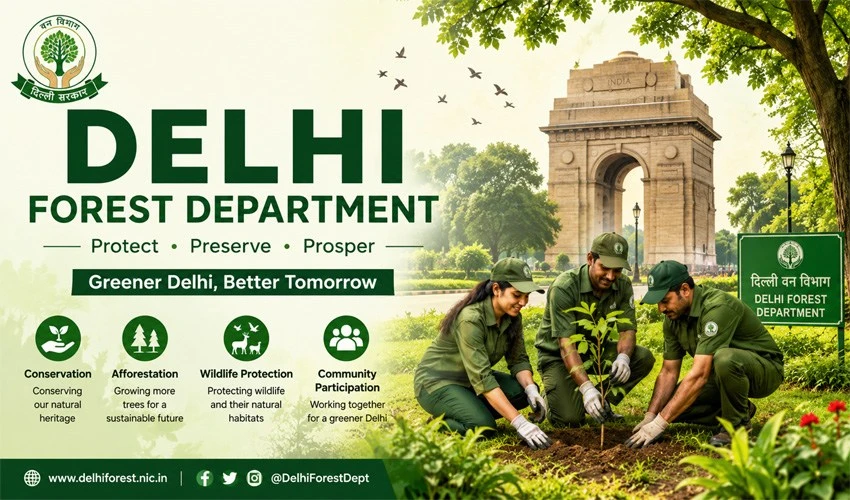
Delhi, India’s bustling capital, is often associated with heavy traffic, dense population, and rising pollution levels. Yet, tucked within this concrete jungle are ridges, reserved forests, wetlands, and city parks that provide the region with its remaining green lungs. Behind the preservation and expansion of this green cover lies a dedicated government body: the Delhi Forest Department. Functioning under the Department of Forests and Wildlife, Government of NCT of Delhi, this institution plays a pivotal role in maintaining ecological balance in one of the most densely populated urban regions in the world.
This article explores the structure, responsibilities, initiatives, and challenges of the Delhi Forest Department, along with its contribution to making Delhi a more livable and sustainable city.
Understanding the Role of the Delhi Forest Department
The Delhi Forest Department is entrusted with the conservation, protection, and expansion of forest and tree cover across the National Capital Territory (NCT) of Delhi. Unlike forest departments in states with vast rural forest belts, Delhi’s version operates in a highly urbanized setting, which brings its own unique set of challenges. The department must balance infrastructure development, urban expansion, and population pressures with the pressing need to preserve biodiversity and green spaces.
Some of its core responsibilities include:
- Protecting reserved and protected forests, including the Delhi Ridge
- Managing wildlife sanctuaries and biodiversity parks
- Carrying out afforestation and plantation drives
- Preventing illegal tree felling and encroachment on forest land
- Enforcing environmental laws, including the Forest Conservation Act and Wildlife Protection Act
- Running nurseries to supply saplings for public and private plantation
- Educating citizens about environmental conservation
The department works in coordination with other civic bodies such as the Municipal Corporation of Delhi, the Delhi Development Authority, and the Central Public Works Department to ensure that green initiatives are integrated into urban planning.
The Significance of Delhi’s Green Cover
Delhi’s forests and green spaces are not just aesthetic additions to the cityscape; they are essential ecological infrastructure. The Delhi Ridge, often called the “green lungs of Delhi,” is a forested rocky ridge that runs through the city and acts as a natural barrier against dust storms while helping regulate the local climate. It is divided into four major zones: the Northern Ridge, Central Ridge, South-Central Ridge, and Southern Ridge, each supporting distinct ecosystems and wildlife.
Beyond the Ridge, Delhi is home to biodiversity parks, city forests, and wetlands that support a surprising variety of flora and fauna, including several bird species, native trees, and small mammals. These green spaces help:
- Improve air quality by absorbing pollutants and releasing oxygen
- Reduce the urban heat island effect
- Recharge groundwater through natural percolation
- Provide habitat for birds, insects, and other wildlife
- Offer recreational and educational spaces for residents
Given Delhi’s notorious air pollution crisis, especially during winter months, the role of forest cover in mitigating environmental damage cannot be overstated. Every additional patch of green cover contributes, even if modestly, to cleaner air and a cooler microclimate.
Key Initiatives by the Delhi Forest Department
Over the years, the Delhi Forest Department has undertaken several initiatives aimed at expanding and protecting the Capital’s green cover.
1. Citywide Afforestation Drives
The department organizes large-scale plantation drives every monsoon season, often in collaboration with resident welfare associations, schools, corporate organizations, and other government departments. These drives aim to increase the green cover percentage of Delhi, which has historically lagged behind the national target of 33 percent forest cover.
2. Biodiversity Parks
Delhi hosts several biodiversity parks developed in partnership with the Delhi Development Authority and academic institutions. These parks are designed to recreate natural ecosystems that once existed in the region, including wetlands, grasslands, and forest patches, thereby supporting native species of plants and animals that had otherwise disappeared from the urban landscape.
3. Smart Nurseries and Sapling Distribution
The department maintains numerous nurseries across the city where saplings are grown and distributed to citizens, schools, and organizations at subsidized rates or sometimes free of cost. This initiative encourages community participation in urban greening.
4. Tree Transplantation Policy
Given the rapid pace of infrastructure development in Delhi, including metro expansion and road widening projects, tree felling is often unavoidable. To address this, the department has implemented a tree transplantation policy that mandates relocating mature trees instead of cutting them down wherever feasible, along with compensatory plantation requirements for every tree that is removed.
5. Digital Monitoring and GIS Mapping
To improve transparency and efficiency, the department has increasingly adopted technology-driven solutions such as GIS mapping of forest areas, digital tracking of tree plantation records, and online permission systems for tree cutting, making the process more accountable to the public.
6. Wildlife Conservation Efforts
Beyond trees, the department also focuses on protecting urban wildlife. Efforts include rescue and rehabilitation of injured or displaced animals, monitoring of bird populations in wetlands, and awareness campaigns to reduce human-wildlife conflict in areas bordering forest land.
Legal Framework Guiding the Department’s Work
The Delhi Forest Department operates within a robust legal and regulatory framework designed to prevent unchecked deforestation and environmental degradation. Key legislations include:
- The Indian Forest Act, which governs the management of forest land
- The Forest Conservation Act, which restricts the diversion of forest land for non-forest purposes without central government approval
- The Wildlife Protection Act, which safeguards endangered species and their habitats
- The Delhi Preservation of Trees Act, which regulates tree felling within the city and mandates permissions before any tree on private or government land can be cut
These laws empower the department to take action against illegal encroachments, unauthorized tree felling, and activities that threaten protected forest areas.
Challenges Faced by the Department
Despite its efforts, the Delhi Forest Department faces numerous challenges in fulfilling its mandate.
- Urbanization Pressure: As Delhi continues to expand, the demand for land for housing, roads, and commercial development often comes into direct conflict with forest conservation goals.
- Encroachment: Illegal encroachment on forest land, particularly in ridge areas, remains a persistent issue that requires continuous monitoring and enforcement.
- Air Pollution: While forests help mitigate pollution, the sheer scale of Delhi’s air quality crisis, driven by vehicular emissions, industrial activity, and stubble burning in neighboring states, often overwhelms the department’s mitigation efforts.
- Limited Land Availability: Unlike states with vast forest tracts, Delhi’s urban geography limits the scope for large-scale afforestation, pushing the department to focus on smaller green pockets, rooftop gardens, and vertical greening solutions.
- Coordination Challenges: Since urban planning in Delhi involves multiple agencies, effective coordination between the forest department and other civic bodies is essential but not always seamless.
The Way Forward
To strengthen its impact, the Delhi Forest Department continues to explore innovative approaches such as promoting urban forestry models like the Miyawaki method, which allows for dense, fast-growing forest patches even in small urban plots. Public participation through citizen plantation drives, corporate social responsibility partnerships, and educational outreach in schools also remain central to the department’s long-term strategy.
Strengthening groundwater recharge zones, restoring wetlands, and expanding biodiversity parks are likely to remain priorities as the city grapples with both environmental degradation and the urgent need for climate resilience.
Conclusion
The Delhi Forest Department stands as a crucial guardian of the Capital’s shrinking yet vital green spaces. In a city where concrete structures dominate the skyline, the department’s efforts to protect forests, plant trees, conserve wildlife, and enforce environmental laws are indispensable to the well-being of over two crore residents. While challenges such as urban expansion, pollution, and land scarcity persist, continued investment in afforestation, technology-driven monitoring, and citizen engagement can help Delhi move closer to a greener, healthier future. Protecting Delhi’s environment is not the responsibility of the Forest Department alone; it requires the collective commitment of citizens, institutions, and policymakers working together toward a sustainable Capital.